
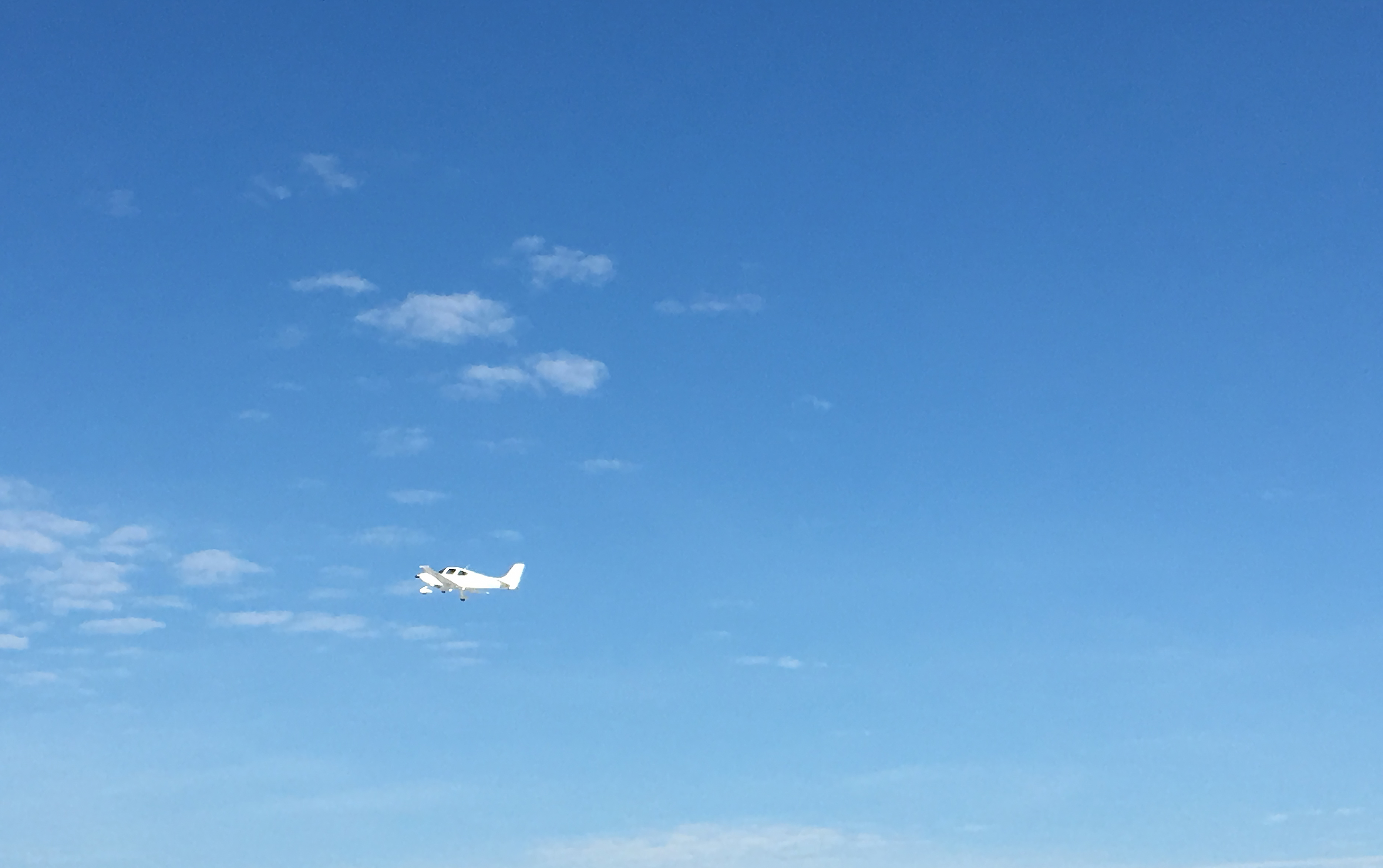
Today we had a beautiful day for flying — the temperature picked up to around 55° F and started to melt some of the snow that’s been sticking around since last weekend. The wind was calm and the skies were clear, as evidenced by this quick shot I took of a low-wing airplane doing pattern work.
My CFI decided we would be heading out to Dutchess County (POU) again. We had an uneventful taxi and takeoff from runway 26 and I flew a right downwind departure to the northwest.
We wound up doing a total of 10 touch and go’s at POU on runway 24. I find I get pretty task-saturated in POU’s pattern — a combination of different radio calls than I’m used to and not being very familiar with the landscape. I’m not proficient yet at picking out landmarks and visualizing my pattern on the fly, so I needed a little coaching from my CFI on when to start my turns. I find I keep making the mistake of not paralleling the runway on downwind — I tend to creep in towards the runway which shortens my base and increases the workload even more.
I kept coming in high on final, so we practiced some steep descents with full (40°) flaps. Since there was no wind I was doing better at tracking the centerline, but I continue to have big issues with the roundout and flare. I’m not able to judge my distance well and keep flaring way too high. The first landing I did was actually pretty good — I saw my instructor kept his hands off the yoke and it was a moderately smooth touchdown. The rest of them, well, they were a bit harder and I needed some assistance to keep us off the nosewheel.
After our time at POU was done, we departed and tracked directly to the Kingston VOR. From there, we flew the 150° radial back to DXR where I entered right downwind for runway 26. I thought I would nail this landing as I’m more familiar with the landscape, but again I was high on approach and bad on the flare.
At least something clicked into place for me — my instructor keeps telling me to look down the side of the plane when going into the roundout and flare. I couldn’t get this through my head — when trying to judge the flare height I was so concentrated on what I was doing with the yoke that I never shifted my vision to the side. Reading the landing chapters in Rod Machado’s How to Fly an Airplane Handbook made some things more clear, and I realized I need to be looking out the “pizza slice” of the windshield — the triangle made by the left side of the cowling, the right side of the window post, and the horizon. My instructor had told me this (minus the pizza reference) but it kept slipping my mind. Hopefully the time I spent after the flight studying and reviewing this will help me with tomorrow’s lesson.
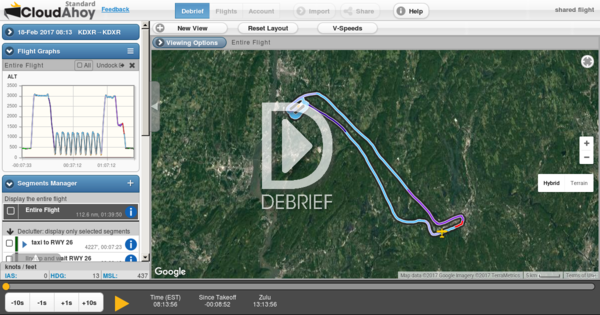
All in all, it wasn’t a terrible flight. It was a beautiful day, and I was very happy with the cruise portion of the flight, where I kept my altitude of 3,000 feet almost perfectly the entire way to POU. That meant I had the plane trimmed properly and was able to correct for minor deviations. The landings are still shaky, but I know that will settle down with time. I also realized my instructor isn’t strictly counting our takeoffs and landings! I tracked the flight with CloudAhoy and was able to go back and see exactly how many pattern trips we made. Although we had a total of 11 takeoffs and landings, my logbook shows 7 each. No worries there, I don’t really care and I was actually wondering how the heck he managed to keep track of all of them during a busy lesson.
Click the image below to view today’s flight:
Flight time today: 1.7 hours
Total flight time to date: 21.3 hours
Total takeoffs to date: 52
Total landings to date: 48