
One day after I got to fly in Florida for the first time, I was scheduled to go up again with the same instructor — this time for a very different experience!
I finished up with the business conference I was at (my reason for being in Florida in the first place) and headed over to FA83, otherwise known as Orlando North Air Park.

Yesterday’s flight had me cruising around with the downtown Orlando skyline in view… today’s setting couldn’t have been more different. FA83 is located in Zellwood, FL which is a pretty rural area. I put blind faith in my rental car’s GPS and it eventually paid off. I turned into the airport and… had no idea where to go. It was just a long road with hangers on the left and farm fields on the right. I didn’t see any runways or anything, so I just started down the road figuring I’d find something airport-like at the other end.
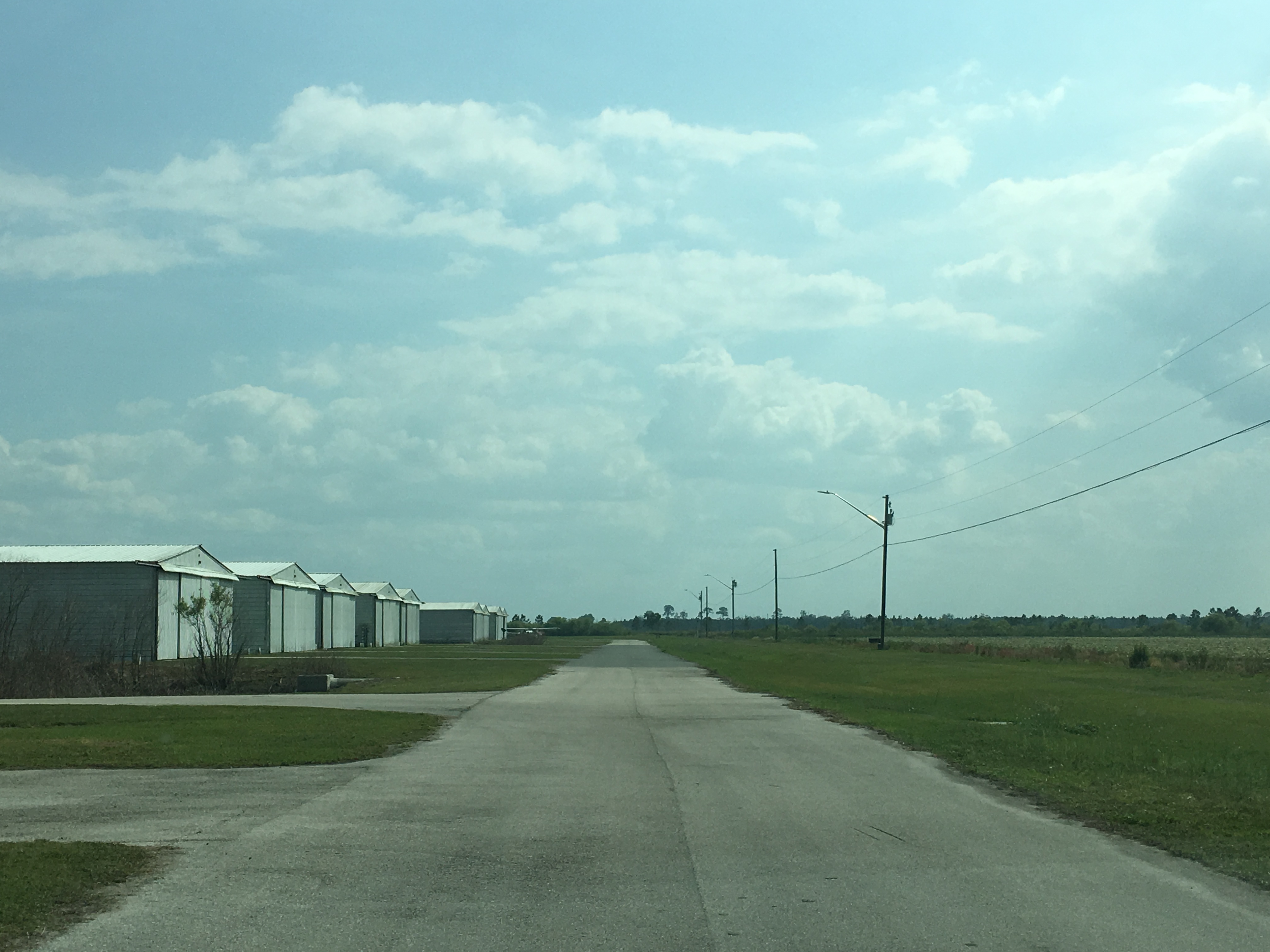
I eventually found the hangar for Van Anda Aviation, which is the FBO at FA83 and who I was renting today’s plane from. My CFI texted me that he was running late (hah! now we were even!) so I chatted up the Van Anda guys for a bit. It was my first real “hangar talk” — I guess I’m getting closer to being a real pilot now!
We were flying N12933 today, a C172M. This was a carbureted model, very similar to the one I fly in CT (same model, but this one was a 1973 versus the 1975 back home). While the plane was similar, the airport was not — this was an uncontrolled, private field that felt like it was in the middle of nowhere! It also had a shorter and narrower runway than I was used to — 50 feet wide and 2,600 feet long (with the runway extending as a turf strip an additional 1,400 feet). This was going to be interesting!
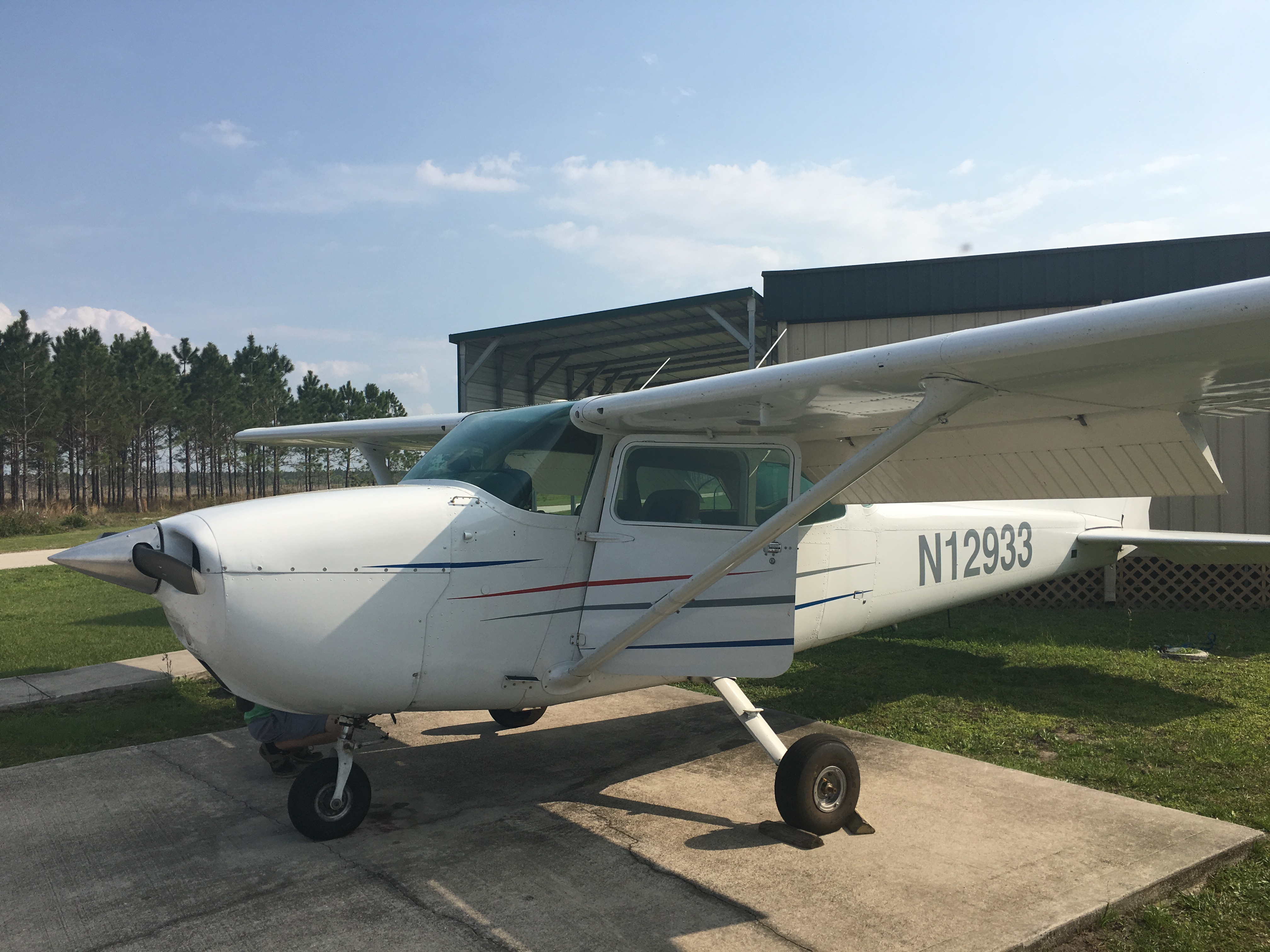
OK — so we get her preflighted and we’re off to the races. My instructor handles the radio work today since he knows I’m going to be a bit overloaded with the different environment. We take off and start flying a pattern.
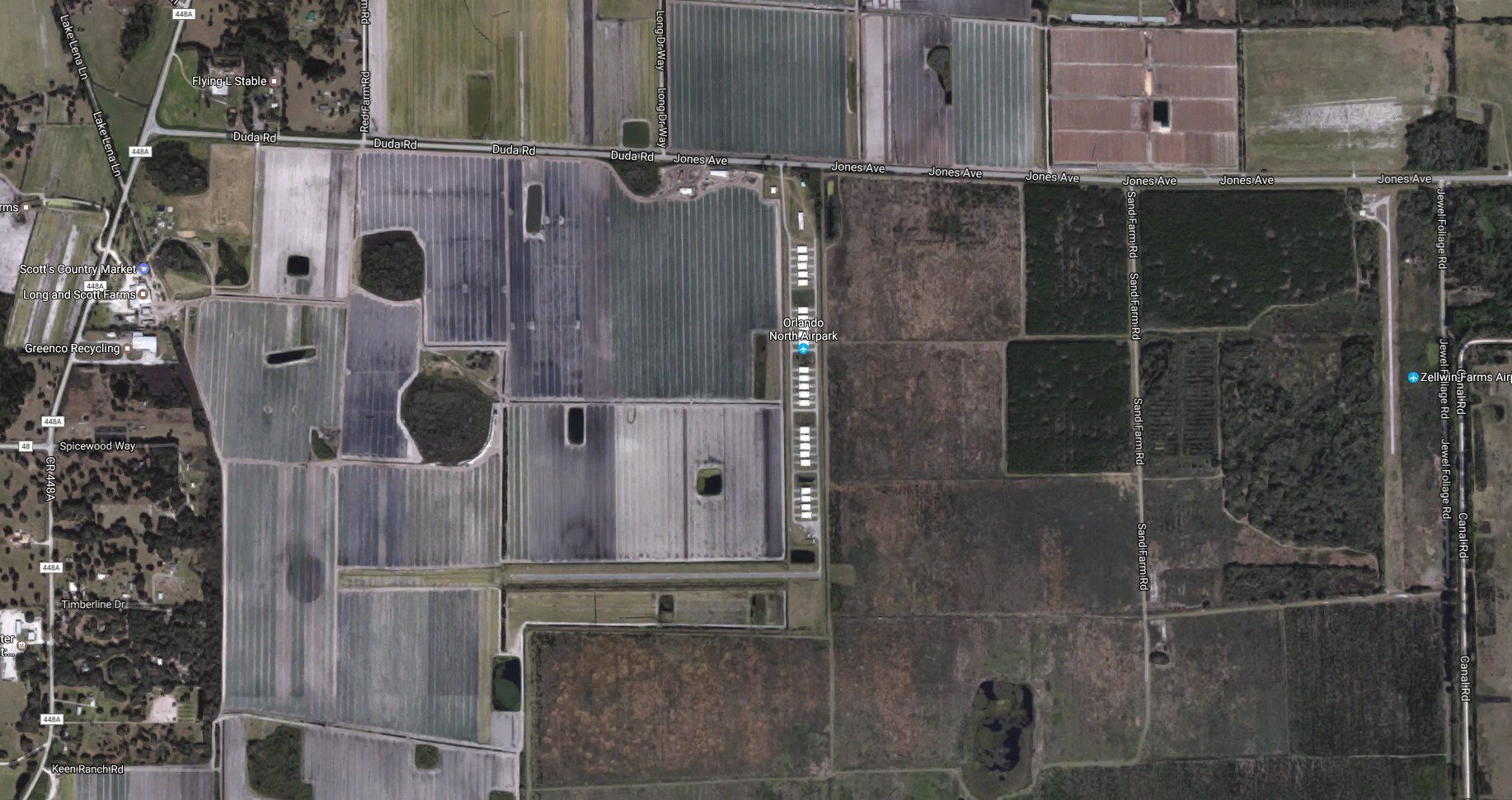
One convenient thing about this area is that there are plenty of straight lines to use to gauge your ground track! Here’s a satellite picture from Google Maps — you can see there are lots of options to keep your pattern lined up (the runway is aligned horizontally and located a little left and below the center of the picture — under the vertical column of white hangars). There wasn’t a lot of wind today, but I still found the ground references helpful.
After yesterday’s work on landings, I thought I was going to kill it today. Turns out that was not the case at all. My first approach I turned on to final and everything was wrong. I was way too high, too fast, and the runway didn’t look right at all. Some of this was not being used to the sight picture of a narrow runway, some of it was because I wasn’t managing the plane properly.
We flew a lot of patterns. My landings pretty much all sucked. I porpoised some, I banged on the nosewheel some, I just couldn’t get the roundout and flare keyed in on this runway. My CFI took the controls to show me the approach and what it should look like and that helped a bit. One thing I liked about this instructor was he let me make mistakes like bouncing the plane. Then I had to fix the mistake — just like I would if he wasn’t in the plane! That took me a couple times to realize — the last time I porpoised I quickly hit the throttle and turned it into a go-around instead of trying to force the plane down when I had way too much energy.
We also visited a nearby grass strip — that was pretty wild! Talk about a different sight picture, now there was no real “runway” to speak of, just a nice flat patch of grass! I did a landing there and my CFI showed me the soft field takeoff technique, where you assume the ground is muddy and you want to prevent getting the nosewheel stuck. You never stop moving, and you keep pressure off the nosewheel by pulling aft on the yoke. You get the plane into ground effect and then pitch the nose down to keep it there and build up speed until you can start a normal climb.
Soon it was time for a full stop landing, so I got us on the ground and we headed back to the tie-down spot. I was disappointed with my performance during this flight, but my instructor told me not to be — after all, I had been given a ton of new variables to work with. I appreciated the positive attitude and I know he’s right, but it’s still a little frustrating to continue to struggle with what I feel are pretty basic tasks.
With that, my time boring holes in the skies of Florida had come to an end. I settled up my bill and headed to Orlando International (MCO) to catch my commercial flight back home.
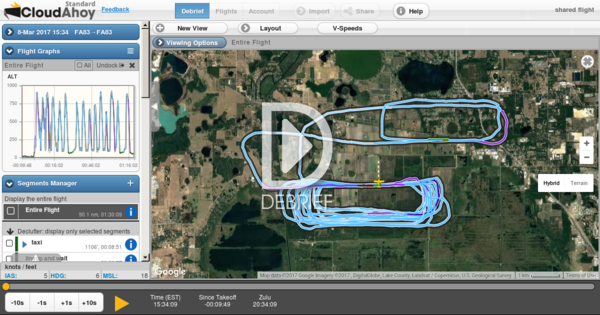
I did remember to record today’s flight — click below to check out the CloudAhoy debrief.
Flight time today: 1.5 hours
Total flight time to date: 29.3 hours
Total takeoffs to date: 101
Total landings to date: 97