Getting ready to solo

With my pre-solo checkride taken care of, I just need a signoff from my CFI and a good weather day and I’ll be flying by myself! I’d be lying if I said I wasn’t nervous, so I wasn’t too upset when my CFI told me today wasn’t the day (it was a bit too windy).

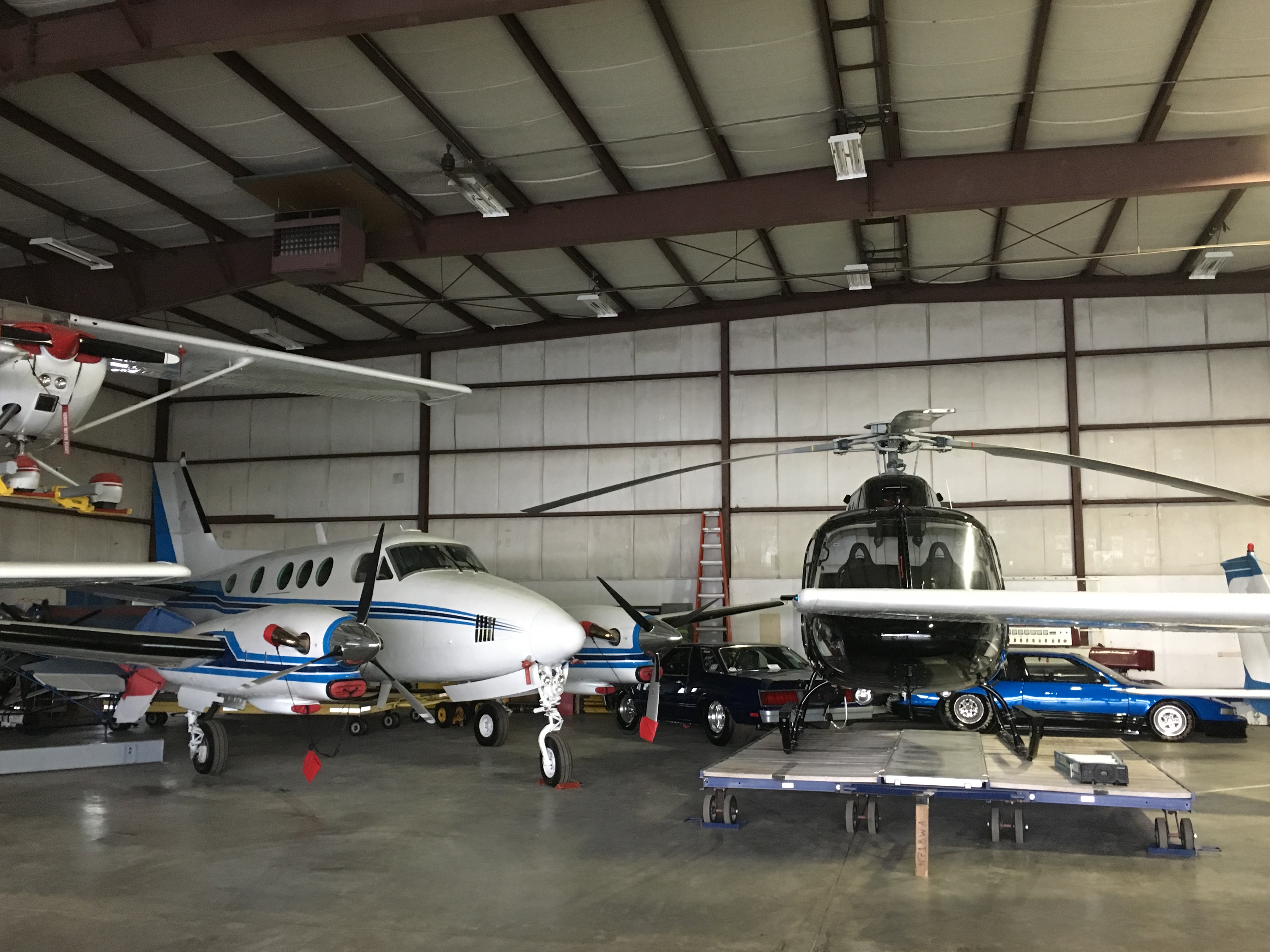
I don’t have an appropriate picture for today, so instead here’s a shot I took of some cool flying machines in the hangar:

Planes and helicopter in the hangar

We went up for some pattern work and landing practice. My CFI “failed” my airspeed and attitude indicators — surprisingly, I think I flew my best patterns to date without them! I felt ahead of the plane and was really working to make sure I could do this alone without input from my instructor. He threw in a simulated engine out to keep me on my toes — I handled it pretty well (we got on the ground in one piece at least!)

My landings are slowly getting better as well — I feel like my timing on the roundout and flare are improving, but today I developed this annoying habit of twisting the yoke as I pulled aft in the flare. It caused the plane to go off the centerline and my instructor was not happy with this turn of events (no pun intended).

Next time we’ll be doing more of the same and trying to get to the bottom of this new yoke-twist thing I’ve got going on.

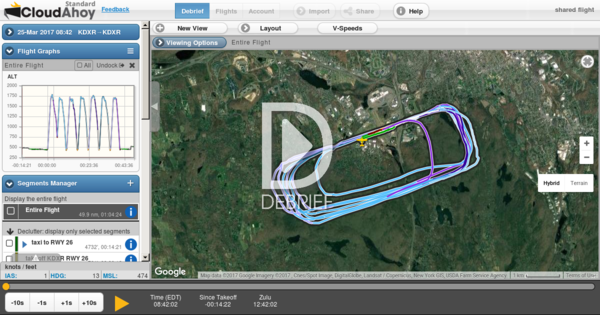
Click the image below for the CloudAhoy track of today’s flight.

CloudAhoy flight - 03/25/2017

Flight time today: 1.4 hours
Total flight time to date: 33.2 hours
Total takeoffs to date: 111
Total landings to date: 107

Flying in Florida: Part 1

I was scheduled to head down to Florida on business and I decided it would be fun to try and take a flight lesson with an instructor down there. After making a few calls, I scheduled two lessons during my trip with a local CFI who had been recommended to me.

My first lesson was flying out of Orlando Executive (KORL). Executive is a Class Delta airport in close proximity to downtown Orlando and Orlando International (KMCO) — it actually sits right under one of MCO’s Class Bravo shelves.
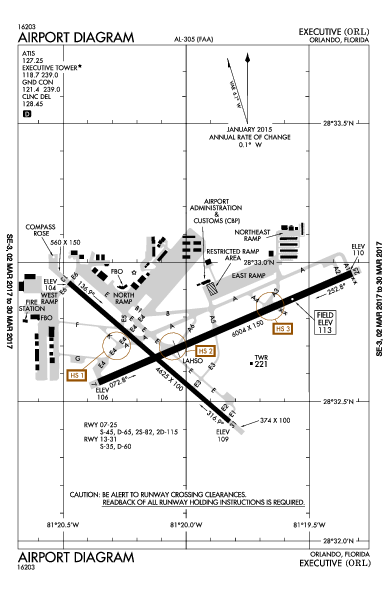
KORL

I was pretty nervous heading to my lesson as I had never flown with anyone besides my instructor back home. The ridiculous Orlando traffic (thanks to I-4 construction) certainly didn’t help my stress level. I would up being 20 minutes late, for which I apologized profusely! Way to make a good first impression.

I had spoken to the instructor on the phone and told him where I was at with my flying and that I wanted to work on landings. We sat and spoke for a bit before heading out to the plane and briefed how the lesson was going to go. We were planning on staying in the pattern and working exclusively on landings and pattern management.

We headed to the plane and did the preflight check. The plane was a 172R model — this model is fuel injected instead of carbureted, so the engine startup was slightly different. No big deal, though, and soon we were taxiing to the runup area.

I was having trouble steering the plane to the left — I would be pushing the rudder pedal all the way in and the plane would barely be turning to the left. I had to use the left brakes more than usual to keep the plane where I needed it. I should’ve mentioned this right away to my CFI but I thought it was more a pilot/technique issue than anything mechanical! More on that later.

We took off from runway 7 and started our pattern work. It was nice having some different scenery to look at! Our downwind leg took us directly towards the Orlando skyline which was pretty cool. I didn’t take this picture, but this is pretty close to our view on downwind (we were lower and more to the left).
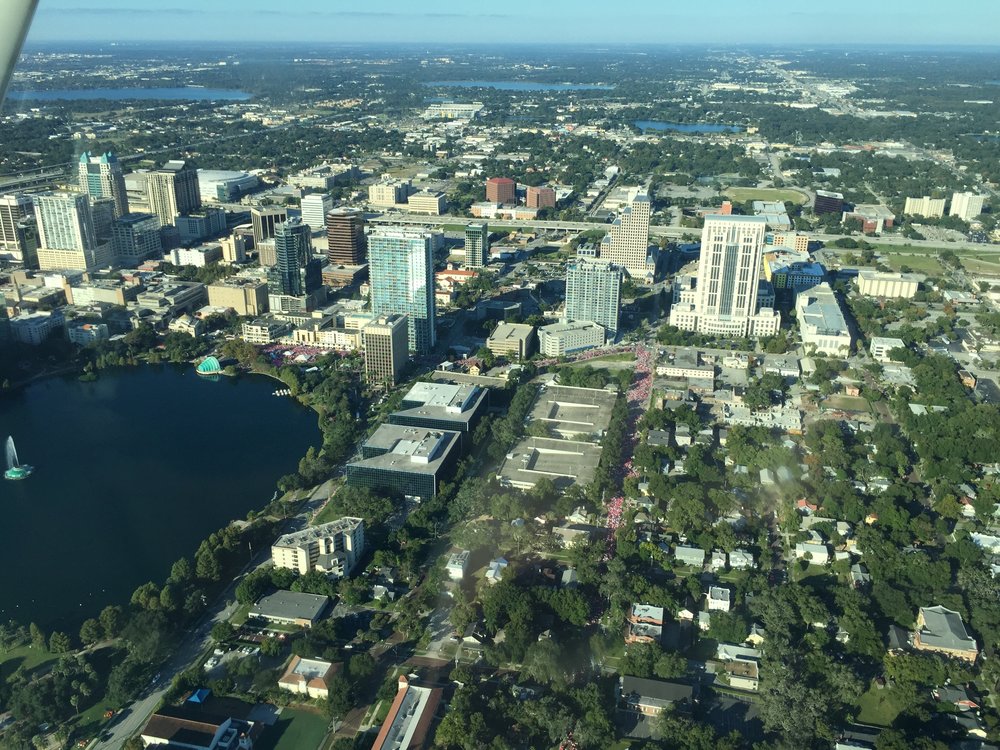
Orlando, FL skyline

I really enjoyed flying with this CFI! He had a good teaching style and he shared the same views on flight instruction that my CFI back home does — namely, all of the information you need to fly the plane is available out the window. He emphasized this by failing almost all of my instruments. I had to climb out to pattern altitude with no altimeter, and when I thought I was there we would check and see how I did. I was coming in consistently low by 500-1,000 feet, but that wasn’t bad considering I was in a new environment for the first time.

We went over energy management techniques to help keep the plane at the right speeds while flying the pattern. We also did a lot of landings! I had one where it felt like everything clicked and I definitely feel like I’m getting closer to “getting it”. I also had some lousy ones, so I’m not there yet!

We also trained on some stuff that was new to me — using slips to lose altitude quickly and simulated engine outs on takeoff (where I had to then manage my energy to land the plane smoothly without nosing it into the runway). I also got a bunch of crosswind work — the winds weren’t as strong as they’ve been back home, but there was a decent crosswind so I worked on holding a proper ground track and keeping the plane lined up on final.

All in all, it was a great experience and I’m really happy I did it. I got to see some cool planes at the airport (the new HondaJet looks very nice!) and got a great view of a Learjet landing while I was in the pattern.

Taxiing back to the ramp I again had some trouble with that left turning, so I mentioned it to my CFI. He took the controls and agreed something felt off and he would mention it to the aircraft owner. I realized then I should’ve mentioned this as soon as I noticed it — what if they thought my wonderful landings had caused the issue?!?

We had a great talk after the lesson — we discussed the flight and flying in general. The instructor had some kind things to say about my flying and level of experience overall. According to him, I’m on track and right where I need to be.

Extra bonus today — the second page of my logbook is now full! On to page 3!

Flight time today: 1.5 hours
Total flight time to date: 27.8 hours
Total takeoffs to date: 89
Total landings to date: 85

Simulating the traffic pattern and go-arounds

Today I got one step closer to being able (and allowed!) to land the plane.

We started off in the classroom reviewing the traffic pattern. Basically, the traffic pattern is a standard set of rules planes are supposed to follow when arriving at and departing an airport. This way everyone knows where everyone else is supposed to be and there is less chance of a collision in the busy airport environment.

Standard traffic pattern
Standard (left hand) traffic pattern

Well, my instructor wasn’t going to set me loose in the actual pattern just yet. Instead, we headed out to the practice area and flew a simulated pattern. He gave me some reference points to base the pattern around and we went through the whole process as if we were in the real pattern — slowing the plane down for landing, lowering the flaps at the appropriate points, etc… Then, when we were on “final approach” he had me initiate a go-around procedure.

The go-around is a very important tool in the pilot’s arsenal. Anytime a landing doesn’t feel right — if the approach is not stable, or if anything seems off — you should immediately initiate a go-around and start over. A lot of pilots have killed or injured themselves by trying to force a landing when they should’ve gone around and set up again. You also need to be able to do a go-around if ATC instructs you to — maybe there has been a runway incursion by another plane or they need to close a runway for some reason — you never know!

I performed the go-arounds by applying full power and starting a climb, gradually cleaning up the flaps as we gained altitude and speed. Then we just transitioned right back into flying the pattern again and setting up for another landing.

My instructor also threw me a curveball when he “failed” my airspeed indicator for a little while — covering it with a rubber disc so I couldn’t see it. I was expected to get the airplane to the correct speeds by feel — listening to the engine, looking at the pitch of the place, how quickly we were moving across the ground, etc… I nailed this a couple of times, and others I was as much as 10mph off. It was a good learning experience. It sounds impossible but my CFI compared it to driving — you can drive without looking at your speedometer and be pretty close to your intended speed. You know what 30mph looks and feels like, you know what 60mph looks and feels like… eventually I will have that same level of intuition and comfort flying this plane.

When we were done practicing I started flying us back to DXR — I was hopeful that I might be allowed to do my first landing, but alas! It was not to be. A couple of planes were all converging at the airport at the same time as us and my CFI deemed it a bit too busy.

I’m still not confident in my ability to fly the real pattern, but my instructor assured me I will get a LOT of practice in this area!

Flight time today: 1.0 hours
Total flight time to date: 10.1 hours
Total takeoffs to date: 4