A whole new world

Apologies in advance for the deluge of words to follow.

It’s been quite some time since I last posted, and I apologize for that. The truth is that I had some pretty big upheavals in my training and I’ve been focused on dealing with them and trying to forge a path forward towards getting my certificate.

Let’s start at the beginning. When I left you last, I had just performed my first unsupervised solo, and my CFI wanted me to get around four hours of solo time before reporting back to him. Our next step was going to be flying our dual cross country flight. Well, I showed up at the airport one day and he took me aside and told me he was no longer able to act as PIC for medical reasons. He wasn’t sure when he would be fit to fly again, but it definitely wouldn’t be for awhile.

This was a pretty big shock — I loved my instructor and I was apprehensive about continuing my training with someone new. At the same time, I wound up joining a local flight club — I hadn’t planned on joining them quite so soon, but as chance would have it a spot opened up on the waitlist and I was in! They had instructors I could train with, but they didn’t have any Cessnas — I would be flying Piper Archers. They also fly out of White Plains (KHPN), which is a much larger and busier airport than Danbury. I wasn’t opposed to training with them, but I sort of retreated back to what was comfortable and decided to take a few more lessons at Danbury while I figured out what to do.

This is where Duke entered my life.

I flew another solo flight on 6/25 and was feeling a little iffy — I was safe and got the plane down OK, but I felt like I needed more practice and my confidence was low since my last flight was all the way back on 6/8. I also needed an instructor to show me how to get to the practice area a bit North of the airport. I got myself on the schedule with a new CFI and hyped myself up — flying with someone new would be good and would teach me new things. This would be a good move!

Well, I showed up at the airport and the guy never showed. I wasted an hour driving back and forth and some more time waiting to see if he was going to come in. I was pissed, and the school knew it. They offered to pair me up with Duke and he was willing to fly with me on the 4th of July. I accepted and showed up to meet Duke on the 4th.

Duke was great — we flew out to the practice area and practiced steep turns and stalls. We flew around a bit and he showed me some landmarks and taught me some things about our surrounding area. I ended that flight feeling pretty good about things, although my landings were crap. Then, I hurt my foot.

I wound up with some weird tendonitis/inflammation in my foot over the holiday weekend, and it kept me from flying for a month. When I returned to the airport on 8/6, I pulled a three hour lesson with Duke. We flew to KPOU and practiced landings, then navigated back to KDXR for some more landings. By the end of the lesson we were both spent. It was a good lesson and I left feeling great about continuing my training with Duke. We made plans for another flight on 8/12 to work on VOR navigation and I shook his hand and went home.

I never saw Duke again.

Tragically, Duke Morasco was killed in a training flight on August 11, 2017. It was a pretty nice day out and Duke was up with a 17-year-old female student with her father riding along as a passenger. They crashed not far from the runway at Candlelight Farms (11N), a grass strip close to Danbury. My wife texted me a news article about the crash while I was at work and I noticed the plane was owned by my flight school. Then I saw the picture of the plane and immediately recognized it as N1727V. I logged into our scheduling application and my worst fears were realized — Duke was the instructor scheduled in that plane that morning.

I was shell-shocked. This was the first death I had encountered up close in aviation, and the fact that it was my instructor in my training plane hit really close to home. I have to admit, I had some doubts about continuing my training after that. I did some soul searching and spoke to some fellow pilots online. I came out of it realizing the risks were exactly the same now as they have been the entire time I’ve been training. It’s scary to think that someone like Duke, a very experienced pilot, could be gone in a flash, but that’s the danger we all accept when we climb into the cockpit. I’m still waiting for more info on what happened during this flight — the armchair quarterbacks seem to think it was a spin stall at low altitude, but nothing official has been said yet. I’m not sure if we’ll ever have any answers. I’ll write more about the feelings I had during the hours following the accident, as I think it’s an important topic for new pilots, but that’s best saved for a separate post.

Here’s I picture I took of N1727V early in my training. You can click on the link above to the news article to see the picture of the plane after the crash.
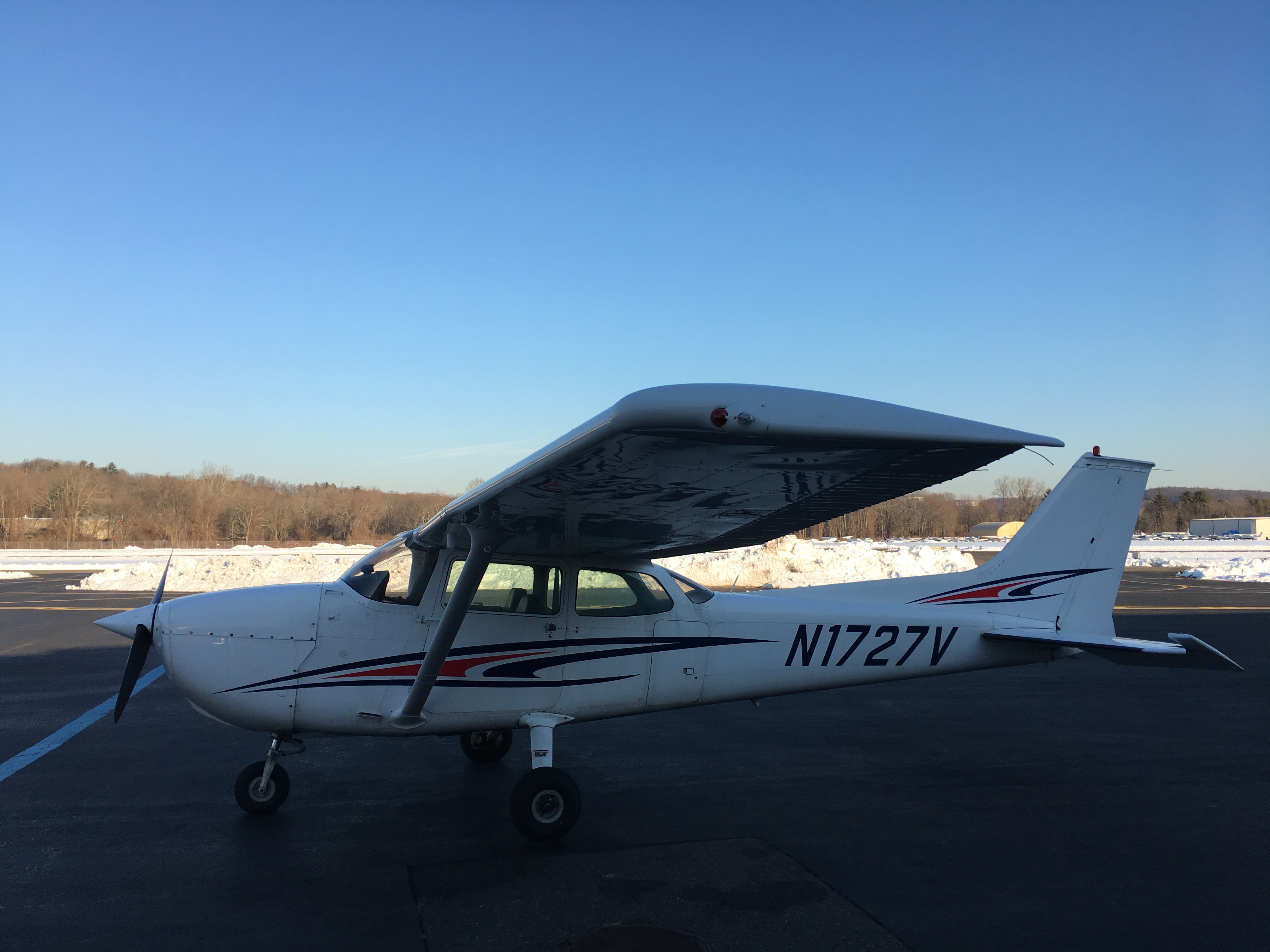
N1727V

I attended Duke’s wake and it was very touching. We had to wait in line for over two hours at the funeral home, that’s how many people came out for this man’s wake. Talking to his family and friends confirmed what I already knew — Duke was a great guy, always willing to help everyone around him, and he was a great pilot who was taken from us too soon. One day I’ll write a post with some more about him — I didn’t know him well, but I’m really glad I got to spend as long as I did in the plane with him.

Anyway, this is turning into a novel, so I’ll try and finish up. I started training with my new school and my new instructor. It is very different — we are doing “real world” flying — going to different airports and parking, getting fuel, etc… I’ve done two flights already — one to KPOU and the other to KHVN. Flying in and out of KHPN is a whole new experience — when JetBlue and Delta are sharing an airport with you, you have to up your game!

So, I will be picking up on the blog with my new training experiences going forward. In the near term, I’ll be working on my cross country planning as well as getting checked out to solo in the Piper Archer. It is different flying the Piper, but I really like it so far. Another nice part about flying a club plane as opposed to a school plane — the amenities! I’m getting experience with new avionics and features like autopilot and rudder trim that N1727V didn’t have.

In closing, I’m excited about finishing up my training and getting my certificate. I love my new instructor and the club is full of great pilots I can learn a lot from. The new airport and environment is challenging and I feel like this is pushing me to a new level with my flying. All in all, I feel like I took a couple steps backwards but this will lead to a huge leap forward. I was getting pretty sick of pattern work at Danbury, so it’s nice to actually fly around and get to see some new things.

I’m sorry for the delay in posting, but I needed some time to get my head on straight and figure out how to handle all of this. I’m looking forward to sharing this new chapter in my training with you! It’s fitting that this post comes as I completed the fourth page of my logbook. New page, new adventures. Blue skies!

Updated Totals:
Total simulated instrument flight time to date: 0.6 hours
Total PIC time to date: 4.7 hours

Total flight time to date: 58.4 hours
Total takeoffs to date: 218
Total landings to date: 214
A wacky, windy day

I was certain we wouldn’t be going up today. The forecast wasn’t too bad when I left my house (6kts at DXR), but it was supposed to kick up pretty bad as the day wore on. I was going to skip the lesson, but decided to head to the airport because I had some questions for my CFI on my cross country plan and needed to pick up a textbook I had on order.

I got to the airport and was surprised when my CFI said we’d be doing some flying! He wanted to practice some maneuvers since I would soon be flying with another CFI and I would be tested on things like stall recoveries and steep turns.

We preflighted the airplane and climbed in. He told me my first task was to fly him to Dutchess County (POU) and pretend he wasn’t in the plane. I could use whatever resources I wanted to get us there. I felt a surge of excitement — here it was, the first simulation of what it would be like flying solo!

Solo flight


I took off and used the Carmel VOR to point us in the right direction. It was real choppy at 3,000 feet, so we climbed to 4,500 to get some smooth air. We were planning on practicing landings at POU as the winds were pretty calm (only 3kts). Turns out everyone else had the same idea and when we got there we found the pattern was a bit crowded.

We asked for a right base to runway 6 which would have made sense given the direction we were coming from. The controller gave us the approval, then rescinded it a couple minutes later because he had traffic coming from the opposite direction. He told us to join a downwind for runway 6, which meant we had to fly out of our way into a strong headwind. That killed some time.

I got established in the pattern and was on final when the tower told us to go-around. A plane had landed a few minutes before us and had not fully cleared the runway yet. It was good to get some go-around practice, in a real-world scenario to boot! We worked our way back around the patter and the winds were starting to get stronger near the surface. We came in for a pretty crappy landing and my instructor decided we’d head back — conditions were not improving.

We departed and headed back to Danbury. The turbulence was kicking us around so we climbed to 5.500 feet to escape it. To be honest, the winds were really putting me behind the plane — they weren’t even that strong, but I was constantly working to keep the plane flying straight and level as gusts knocked us up, down, and sideways. If I had truly been flying solo I would’ve been really nervous.

We scratched the plan to work on maneuvers since it was getting pretty crappy out and we set ourselves up for a long final into runway 35. As we were getting established and coming down to pattern altitude, the winds were getting a bit crazy. My instructor took the plane and took us in for the landing. I just sat there and watched in awe. He was completely focused, constantly working the throttle and ailerons to battle the winds as we came into the valley before the runway. There are some wicked updrafts and downdrafts caused by the terrain on that approach, so you really have to be on top of your game!

He brought us in for a nice landing, and right before touchdown a gust almost knocked us off the runway path. My CFI expertly fought the plane back and got us on the ground. It was pretty impressive to watch. He apologized for taking the landing away from me, but I had no problem with that…I told him, “I’m really glad you know what the hell you’re doing because I’d probably be dead right now if I’d tried that landing.” Eventually I’ll be able to deal with that kind of stuff, but I know for certain I’m not there yet.

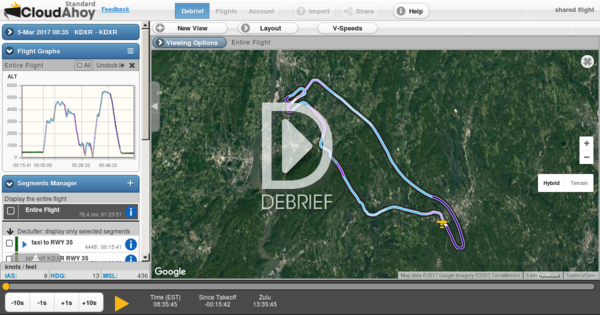
Click the picture below to see the CloudAhoy debrief for this flight.

CloudAhoy flight - 03/04/2017

Flight time today: 1.3 hours
Total flight time to date: 26.3 hours
Total takeoffs to date: 75
Total landings to date: 71


Another trip to POU

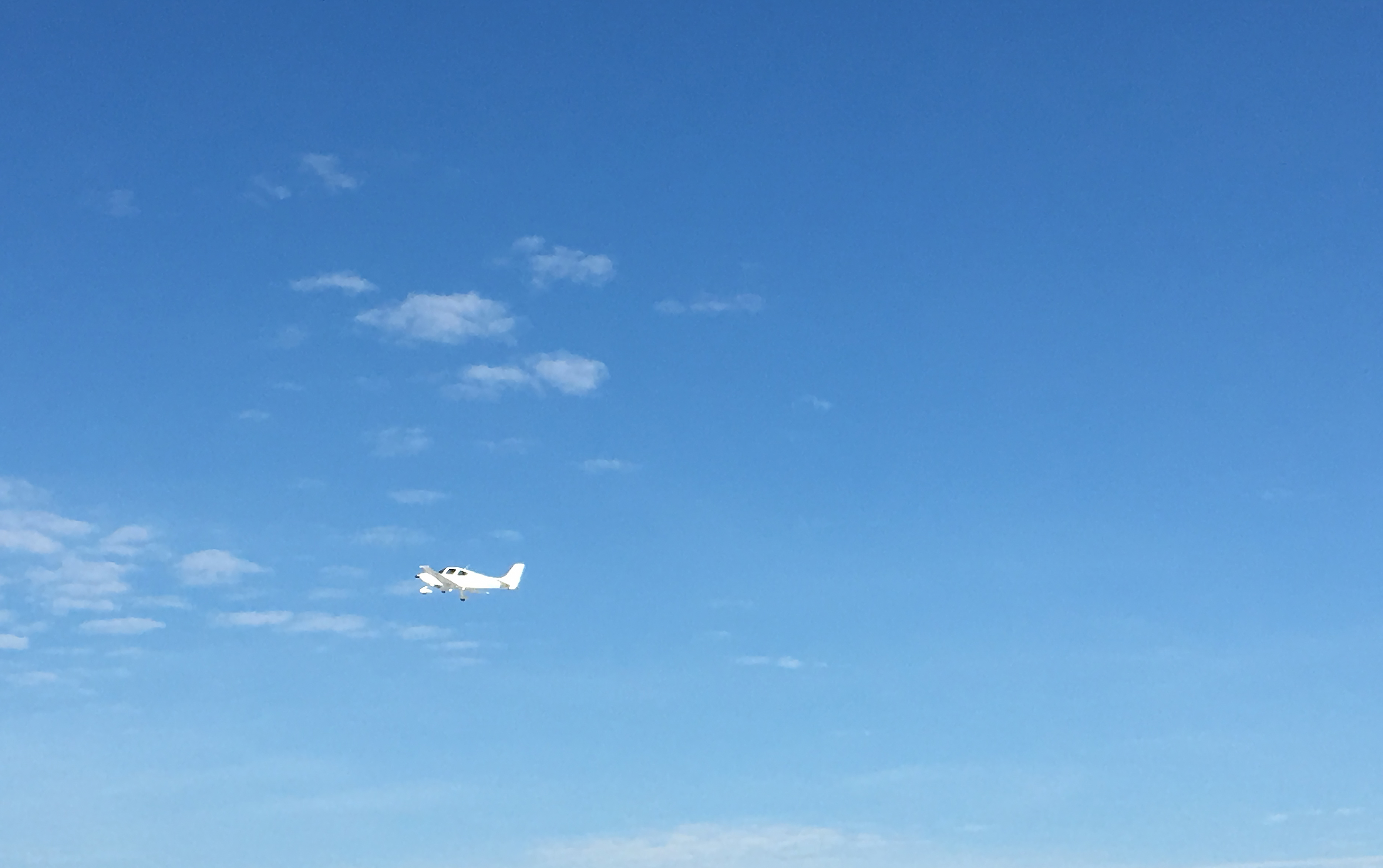
Today we had a beautiful day for flying — the temperature picked up to around 55° F and started to melt some of the snow that’s been sticking around since last weekend. The wind was calm and the skies were clear, as evidenced by this quick shot I took of a low-wing airplane doing pattern work.

Plane in the pattern at DXR

My CFI decided we would be heading out to Dutchess County (POU) again. We had an uneventful taxi and takeoff from runway 26 and I flew a right downwind departure to the northwest.

We wound up doing a total of 10 touch and go’s at POU on runway 24. I find I get pretty task-saturated in POU’s pattern — a combination of different radio calls than I’m used to and not being very familiar with the landscape. I’m not proficient yet at picking out landmarks and visualizing my pattern on the fly, so I needed a little coaching from my CFI on when to start my turns. I find I keep making the mistake of not paralleling the runway on downwind — I tend to creep in towards the runway which shortens my base and increases the workload even more.

I kept coming in high on final, so we practiced some steep descents with full (40°) flaps. Since there was no wind I was doing better at tracking the centerline, but I continue to have big issues with the roundout and flare. I’m not able to judge my distance well and keep flaring way too high. The first landing I did was actually pretty good — I saw my instructor kept his hands off the yoke and it was a moderately smooth touchdown. The rest of them, well, they were a bit harder and I needed some assistance to keep us off the nosewheel.

After our time at POU was done, we departed and tracked directly to the Kingston VOR. From there, we flew the 150° radial back to DXR where I entered right downwind for runway 26. I thought I would nail this landing as I’m more familiar with the landscape, but again I was high on approach and bad on the flare.

At least something clicked into place for me — my instructor keeps telling me to look down the side of the plane when going into the roundout and flare. I couldn’t get this through my head — when trying to judge the flare height I was so concentrated on what I was doing with the yoke that I never shifted my vision to the side. Reading the landing chapters in Rod Machado’s How to Fly an Airplane Handbook made some things more clear, and I realized I need to be looking out the “pizza slice” of the windshield — the triangle made by the left side of the cowling, the right side  of the window post, and the horizon. My instructor had told me this (minus the pizza reference) but it kept slipping my mind. Hopefully the time I spent after the flight studying and reviewing this will help me with tomorrow’s lesson.

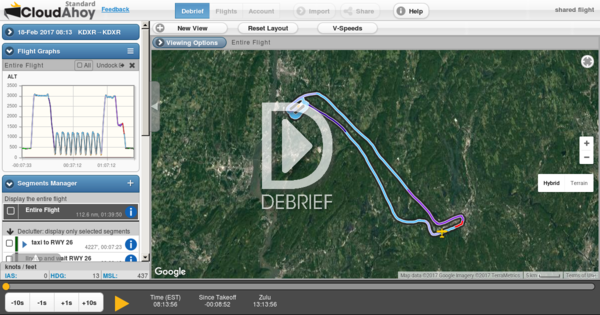
All in all, it wasn’t a terrible flight. It was a beautiful day, and I was very happy with the cruise portion of the flight, where I kept my altitude of 3,000 feet almost perfectly the entire way to POU. That meant I had the plane trimmed properly and was able to correct for minor deviations. The landings are still shaky, but I know that will settle down with time. I also realized my instructor isn’t strictly counting our takeoffs and landings! I tracked the flight with CloudAhoy and was able to go back and see exactly how many pattern trips we made. Although we had a total of 11 takeoffs and landings, my logbook shows 7 each. No worries there, I don’t really care and I was actually wondering how the heck he managed to keep track of all of them during a busy lesson.

Click the image below to view today’s flight:

CloudAhoy flight - 02/18/2017

Flight time today: 1.7 hours
Total flight time to date: 21.3 hours
Total takeoffs to date: 52
Total landings to date: 48

First trip to another airport! DXR to POU

Today was the day! My first landings at another field. My CFI informed me we would be heading to Dutchess County (POU) today. We headed to the classroom to brief for the flight.

We broke out the sectional and examined our route of flight. I was told we would be departing DXR to the west and intercepting the Carmel VOR’s 340° radial. This would take us more or less direct to POU. On the way back we would tune the Kingston VOR and fly the 150° radial back to Danbury. We also discussed pilotage options — basically, following some prominent interstate highways that led from Danbury to Poughkeepsie. I was excited — I had been planning for this flight for a few days now and felt like I was ready.

The mood was lighthearted as I taxied out to runway 26. It was a frigid day so we were expecting good climb performance out of ol’ N1727V. I lined up on the runway and performed the takeoff, holding runway heading until 1,500 feet.

I turned on a heading of 300° and continued climbing to our planned altitude of 3,000 feet. Once we were out of Danbury’s airspace we tuned Dutchess tower and settled into cruise. I was happy to have some time flying (mostly) straight and (mostly) level — all of this rapid fire action in the pattern recently had left me yearning for some cruise flight. I worked on keeping the plane in trim and pointed somewhat on course.

As the CDI needle crept towards center I started turning to intercept the radial. We flew the 340° radial until we were getting close to the airport — it’s only about 25nm from DXR so it didn’t take too long! I called POU tower around 10 miles out and they told me to join a left downwind for runway 24.

KPOU

We started our descent to pattern altitude of 1,200 feet and my instructor pointed out some ground references to keep me on track. We entered the downwind, slowed the plane down, and turned to base where we were given clearance to land. I turned on final and was presented with a PAPI (precision approach path indicator) — a visual indicator of proper glide slope that sits to the side of the runway. I tried to adjust my descent to keep the PAPI lights in the proper configuration. There are four lights on a PAPI — two white and two red mean you are on a perfect glide slope. If you get three or four white lights it means you are above the slope, three or four red mean you are below. We came in for a rather sloppy landing as I still have some issues keeping the plane centered on final.

PAPI lights
An example of a PAPI — the two white and two red lights to the left of the runway

After landing we turned off the runway and cleaned up the plane. We taxied back to runway 24 and I requested permission from tower to takeoff. I had a momentary bout of confusion on the radio — I am so used to flying out of Danbury the different taxiways and runway numbers threw me for a bit of a loop. Soon we were taking off of 24 and flying the POU pattern.

We did another landing, this time a touch and go. I can’t say this landing was any better than the first. Another lap in the pattern — another touch and go and we were back in the air. My instructor told tower we’d be coming in for one more landing and then heading back to Danbury.

One last sloppy landing later and we were heading home, tracking direct to the Kingston VOR. I got my first view of a VOR station from the air. We overflew the VOR as my instructor pointed out the cone of confusion, that area where the CDI needle can’t be trusted as you come directly over the station. I used line of sight to estimate where the 150° radial would take us and held the plane on that track. As we came out of the cone of confusion, I was pleased to see the needle center, confirming I was on the right course.

We called Danbury tower and were given a right traffic pattern for runway 26 as I brought us back to our home turf. I got a bit disoriented approaching the airport as my normal points of reference were all mixed up. Eventually I had us back on the ground with another crappy landing and we taxied back to the ramp.

My landings still need a lot of work, but I felt pretty good about navigating to a different airport and logging my first non-DXR landings. I left the airport today feeling a real sense of accomplishment — even though it was a very short trip, I had successfully navigated to another airport and back! Another five takeoffs and landings for the logbook.

Flight time today: 1.2 hours
Total flight time to date: 18.4 hours
Total takeoffs to date: 40
Total landings to date: 36