A wacky, windy day

I was certain we wouldn’t be going up today. The forecast wasn’t too bad when I left my house (6kts at DXR), but it was supposed to kick up pretty bad as the day wore on. I was going to skip the lesson, but decided to head to the airport because I had some questions for my CFI on my cross country plan and needed to pick up a textbook I had on order.

I got to the airport and was surprised when my CFI said we’d be doing some flying! He wanted to practice some maneuvers since I would soon be flying with another CFI and I would be tested on things like stall recoveries and steep turns.

We preflighted the airplane and climbed in. He told me my first task was to fly him to Dutchess County (POU) and pretend he wasn’t in the plane. I could use whatever resources I wanted to get us there. I felt a surge of excitement — here it was, the first simulation of what it would be like flying solo!
Solo flight


I took off and used the Carmel VOR to point us in the right direction. It was real choppy at 3,000 feet, so we climbed to 4,500 to get some smooth air. We were planning on practicing landings at POU as the winds were pretty calm (only 3kts). Turns out everyone else had the same idea and when we got there we found the pattern was a bit crowded.

We asked for a right base to runway 6 which would have made sense given the direction we were coming from. The controller gave us the approval, then rescinded it a couple minutes later because he had traffic coming from the opposite direction. He told us to join a downwind for runway 6, which meant we had to fly out of our way into a strong headwind. That killed some time.

I got established in the pattern and was on final when the tower told us to go-around. A plane had landed a few minutes before us and had not fully cleared the runway yet. It was good to get some go-around practice, in a real-world scenario to boot! We worked our way back around the patter and the winds were starting to get stronger near the surface. We came in for a pretty crappy landing and my instructor decided we’d head back — conditions were not improving.

We departed and headed back to Danbury. The turbulence was kicking us around so we climbed to 5.500 feet to escape it. To be honest, the winds were really putting me behind the plane — they weren’t even that strong, but I was constantly working to keep the plane flying straight and level as gusts knocked us up, down, and sideways. If I had truly been flying solo I would’ve been really nervous.

We scratched the plan to work on maneuvers since it was getting pretty crappy out and we set ourselves up for a long final into runway 35. As we were getting established and coming down to pattern altitude, the winds were getting a bit crazy. My instructor took the plane and took us in for the landing. I just sat there and watched in awe. He was completely focused, constantly working the throttle and ailerons to battle the winds as we came into the valley before the runway. There are some wicked updrafts and downdrafts caused by the terrain on that approach, so you really have to be on top of your game!

He brought us in for a nice landing, and right before touchdown a gust almost knocked us off the runway path. My CFI expertly fought the plane back and got us on the ground. It was pretty impressive to watch. He apologized for taking the landing away from me, but I had no problem with that…I told him, “I’m really glad you know what the hell you’re doing because I’d probably be dead right now if I’d tried that landing.” Eventually I’ll be able to deal with that kind of stuff, but I know for certain I’m not there yet.

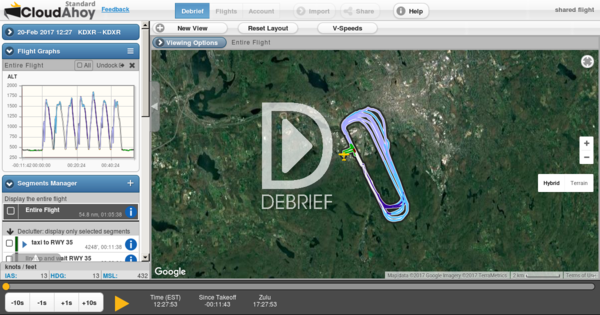
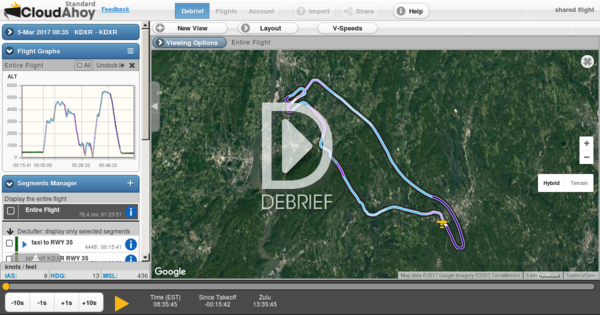
Click the picture below to see the CloudAhoy debrief for this flight.
CloudAhoy flight - 03/04/2017

Flight time today: 1.3 hours
Total flight time to date: 26.3 hours
Total takeoffs to date: 75
Total landings to date: 71
 

The infamous DXR runway 35 approach

I was nervous about today’s lesson.

After the mistakes I made yesterday, I was hoping for a calm day to just work on my landings. I normally try and schedule my lessons for 8am, before the winds start kicking up. Today I was forced to take a 12pm lesson and the METAR was showing winds out of the north at 8kts gusting to 15kts.

Now, those aren’t particularly strong winds, but when you are a low-time student really trying to focus on the pattern procedural flow and landing timing, anything above dead calm will mean a higher workload. Not only was I not getting the glass smooth day I’d been hoping for, but winds from the north also meant Danbury would be using runway 35.

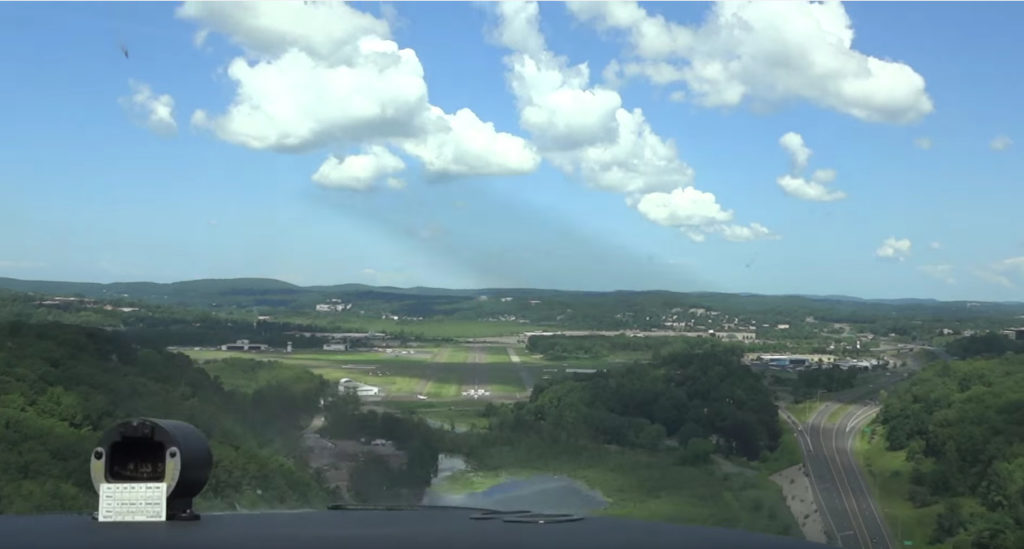
I’ve only flown runway 35 once, and it was before I was doing my own landings. The approach to 35 has a bit of a reputation — due to noise abatement procedures you come in on a rather long final approach which has you flying into a valley between two large hills. According to my CFI, the sun will hit one hill and not the other, causing an updraft on one side and a downdraft on the other and creating a bit of a turbulent vortex in the valley. There is also a pond you fly over right before reaching the runway (you can see it in the below image) which makes its own contribution to the mishmash of air currents during the approach. My instructor claims he knows a couple of commercial-rated pilots who won’t land DXR when 35 is active.

DXR's runway 35 approach
DXR’s runway 35 approach

The image above is from a YouTube video showing the approach — there are a few videos like this and watching them will give you a good idea of the terrain involved. The shot above is from after you are already in the valley — you can’t really see the size of the hills to the left and right, but they are intimidating!

I preflighted the plane and met up with my instructor, who laughed and said, “You’ll be having some fun today!”

“I think our definitions of fun are a little different,” I replied.

So, wonderful — a new approach and pattern to learn, and a challenging one at that. I resigned myself to the fact that I’d be working hard today.

After waiting a bit for the line guys to top off our tanks, we started up and taxied out to runway 35. There is a NOTAM for this runway:

ACFT USING RWY 35 ARE NOT VISIBLE FM THE TWR DESCENDING BLO 1300′ ON BASE LEG TIL APCHG 1/2MI FINAL DUE TO NATURAL TERRAIN.

That means we have to keep an eye on traffic in case the tower doesn’t see an approaching aircraft, so when doing the runup we position the plane so we can watch the final approach path.

We took off without incident and my instructor gave me some pointers on where to turn for the pattern. We did a few laps around the airport — it was challenging, as maintaining altitude required constant attention to the throttle. At one point during downwind I was concentrating on maintaining speed, getting my flaps setup, and calling tower, when my instructor asked, “Hey, how are we doing on altitude?” I took a look at the altimeter and realized we were 300 feet above pattern altitude. Whoops!

And that was just downwind. Turning on to final, we battled the updrafts and downdrafts to keep ourselves on a good descent path. The wind was pretty much straight down the runway so I wasn’t battling too much of a crosswind component, but it was still a challenge bringing the plane down at the right rate. I was constantly adding and removing power to try and stay in a stable approach.

I did a few landings — they weren’t great but I felt they are getting ever-so-slightly better. The fifth landing was a bit dicey as the winds starting kicking more and I started getting behind the plane a bit. My instructor called the lesson at that point — he felt it would be unproductive to continue and I would just get overly fatigued. It was about 20 minutes before we would’ve normally stopped the lesson, but I didn’t mind — I had gotten a taste of this interesting and challenging approach and didn’t want to get to the point where I was making stupid mistakes (like yesterday).

One thing I do like about this approach is the long final leg. I felt like it gave me more time to get aligned with the runway and control the descent. I’d like to request this approach one day when winds are calm so I can get some more experience flying it without battling the crazy wind.

And there’s the rub, right? I know to be a pilot I will need to be prepared for any situation — the winds won’t always be calm, the conditions will not be perfect, and I’m still going to have to get the plane down safely. I understand the experience I gained yesterday and today is very valuable — but at the same time, it is frustrating since I’m trying to perfect my landings. I just want some time to work on final approach, roundout, and flaring with as few distractions as possible. Once I have a comfort level landing in calm conditions, I will welcome the challenge of upping the difficulty and tackling winds and thermals. Right now, though, it is a bit overwhelming.

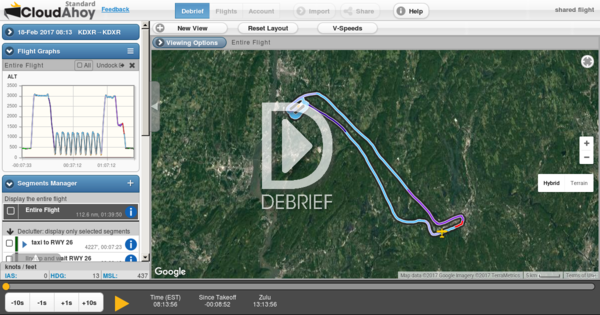
I was able to record today’s flight with CloudAhoy — click the picture below to check it out. Note the elongated pattern due to the extended downwind to avoid overflying the Lake Waubeeka community (which has a bit of an interesting history) on base.

CloudAhoy flight - 02/18/2017

I’ll be doing some pattern work in my home simulator during the upcoming week… it won’t help me with getting the feel of the plane down, but it might help me manage cockpit workflow a little better.

Flight time today: 1.0 hours
Total flight time to date: 23.8 hours
Total takeoffs to date: 64
Total landings to date: 60

Beat up by the crosswinds (and first trip to OXC)

Some days you fly the plane, some days the plane flies you…

Today started off promising. It was another unusually warm day (60° F!), a bit overcast but ceilings well above where I needed them to be, and a little wind. DXR was reporting surface winds of 7kts, and today’s destination, Waterbury-Oxford (OXC), was around 4kts. I didn’t think that would be any kind of challenge — we’ll come back to that in a minute.

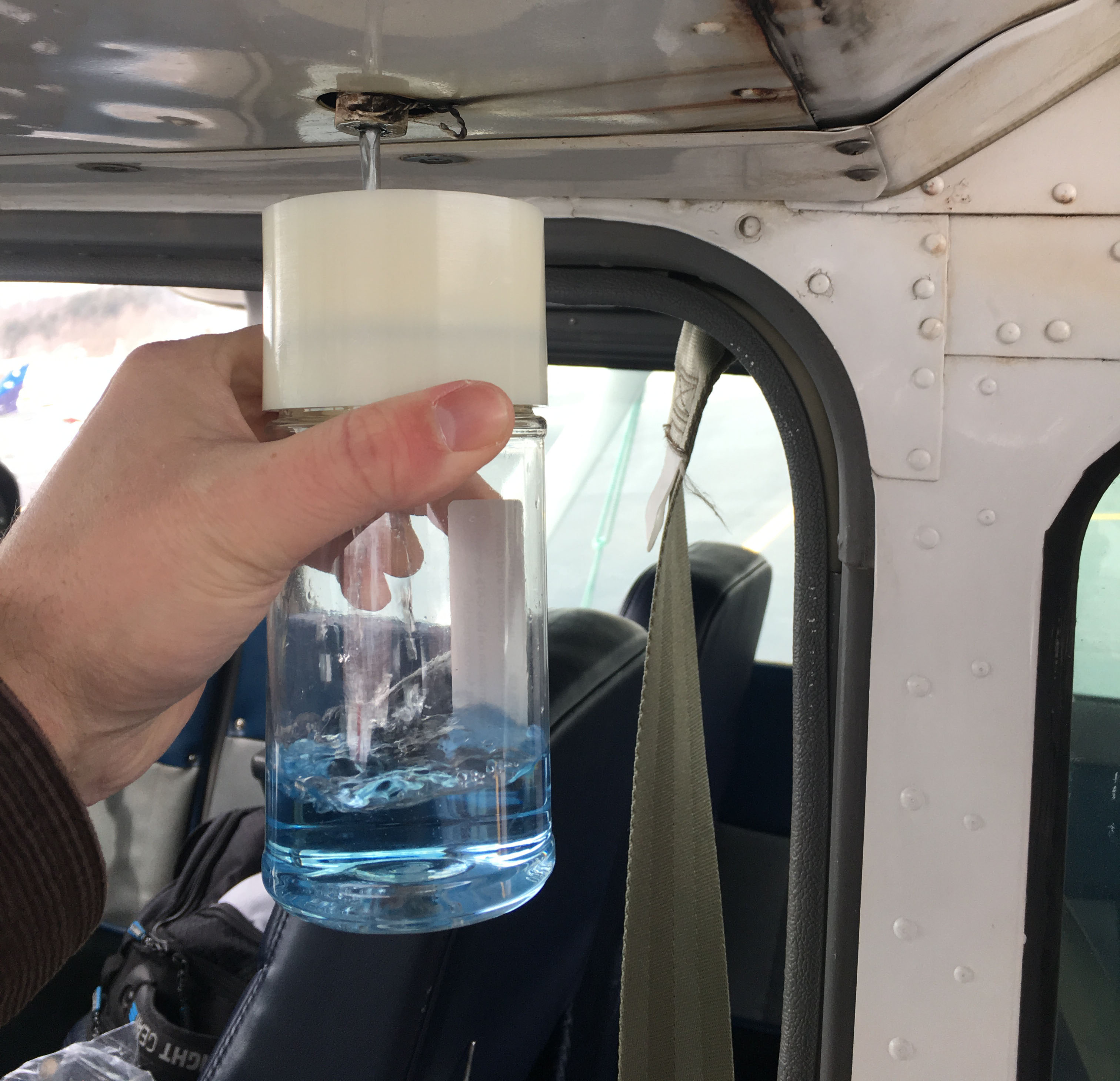
My instructor was still in the air when I got to the airport, so I went out to preflight the plane. Everything looked good, and I even managed to get an action shot of me testing the fuel!

Testing fuel during preflight
I love the smell of 100LL in the morning!

When my CFI arrived, we briefed our flight plan. This would be my first trip to OXC — it’s only about 17nm from DXR, so it wouldn’t take us long to get there. We planned to use pilotage to find our way, following I-84 and the Housatonic RIver as our landmarks. We got into the plane and started her up, and that’s where the day started getting away from me.

First off, I forgot to start CloudAhoy before the flight, so I have no recording of the day’s events. Not the end of the world, but annoying. Next, while taxiing out to runway 26, the plane got away from me a bit when I got uncoordinated on the rudder pedals/brakes. We headed right for a snowbank before my CFI took control and got us back on track. Embarrassing, and I don’t have any excuse — not sure how I got mixed up but it’s a reminder to be extra diligent during ALL phases of flight, especially those on the ground.

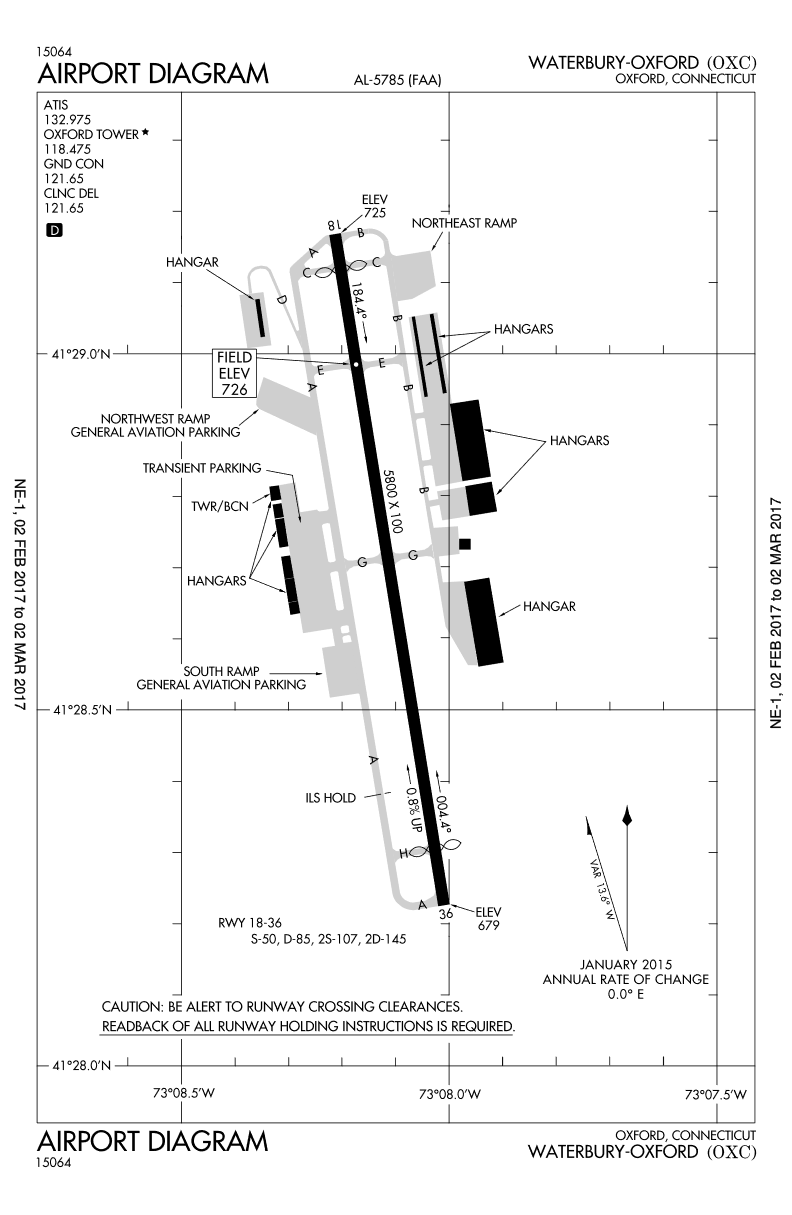
We took off uneventfully and headed over to OXC. Cruise was ok, kept my altitude at 2,500 feet and pointed the plane in the right direction. Radio calls went well and soon we were inbound for a left base to runway 36. Oxford only has one runway (18/36) and the airport is up on a hill, so wind is often a factor. I was about to find out what that meant.

KOXC

We came in for the first landing and I was focused on the review I did yesterday of how to gauge the roundout and flare height. What I was totally unprepared for were some kicking crosswinds! ATIS said the winds were out of 300° at 4kts, but my instructor (and the windsock) indicated they were blowing stronger than that. Now I had to deal with an unfamiliar airport, crosswind technique (which I haven’t had much practice with at all), AND trying to figure this flare height thing out!

We did a full stop landing so I could get a sense of the airport and taxiway layout, then headed back to runway 36 for some touch and go’s. We made a few circuits around the pattern and it got progressively harder for me to keep the plane lined up on final. I’m not used to the concept of landing on one wheel with the wings tilted, so I kept wanting to straighten the plane out before touching down. I needed quite a bit of help on some of these landings.

I was a little better with my approach altitude, but I was still keeping it too high for some of our approaches. I need to learn better power management — something my instructor has been on me for. I have zero finesse when it comes to the throttle and knowing when to add a touch of power or when I need to back it off more to compensate for a too-low descent rate.

Eventually the winds were got a touch too nasty, so we headed back to DXR. We used pilotage again, and we practiced an engine out emergency. My CFI asked where I would go if the engine quit. I looked around — there weren’t a ton of great options, but I spotted some fields that looked like they would work. “OK,” he said, as he pulled the throttle to idle. “Get there!”

I set up for best glide speed of 80mph and he showed me how the wind was slowing us a bit too much so we would actually be better gliding with a bit more speed. We headed towards the fields and would have just cleared some trees and been able to put it down. I got my engine back at the last second and we resumed our trip back to DXR.

We did a couple laps of the pattern at DXR and here’s where things really started falling apart for me. I kept making stupid mistakes. Here’s the ones I remember:

  • On downwind, I added 10° of flaps and instead of returning the flaps switch to “neutral” I put it back to “up” and took the flaps right back out.
  • On a go-around, I thought, “take out 6 seconds (20°) of flaps” — however, that’s when you have flaps fully extended. Instead of bringing the flaps back 10° like I should have, I took them completely out.
  • Same go-around, after taking the flaps out I instinctually pitched the nose down. I guess I was thinking I needed to build up speed, but that’s the wrong thing to do. I should have immediately started climbing.
  • Turning on to final, I was completely uncoordinated, putting left rudder into the turn when I needed right rudder.
  • I kept over-banking my turns in the pattern — this has been a habitual problem for me.
  • I kept pulling back on the elevator and raising the nose when I should’ve been using power to gain altitude, not elevator.
  • When my CFI asked the tower to shoot me a light gun signal so I could see what they look like, I let the nose creep up while I was looking outside for the signal. This was because the plane wasn’t properly trimmed.

Not a shabby list for a few loops around the airport! They were all stupid things that I should know better than to do. And they are all things that could get me in serious trouble if I didn’t have someone in the plane watching over my shoulder. If there was any saving grace, it is that all of these mistakes were likely due to fatigue after the intense workload of the earlier crosswind landings. Even so, it underscored that I have a lot more work to do and that I am definitely not ready to solo yet. It also earned me a review of go-arounds on the next lesson since my CFI was not happy with my performance today.

Our time was up at this point, but my instructor would’ve stopped the lesson there regardless of what time it was — I was showing too many signs of fatigue to continue. I would’ve had no problem with that — as it was, my mind was reeling and I was ready to stop for the day. One silver lining — I did remember to use the “pizza slice” to look for my flare height on this flight. Unfortunately, it didn’t help much with everything else that was overloading me today!

I left feeling a bit down on myself, but tomorrow is a holiday so I have the day off and another lesson booked. If nothing else, this has steeled my resolve to study up tonight, mess around on my sim, and absolutely kill it tomorrow.

Flight time today: 1.5 hours
Total flight time to date: 22.8 hours
Total takeoffs to date: 59
Total landings to date: 55

Another trip to POU

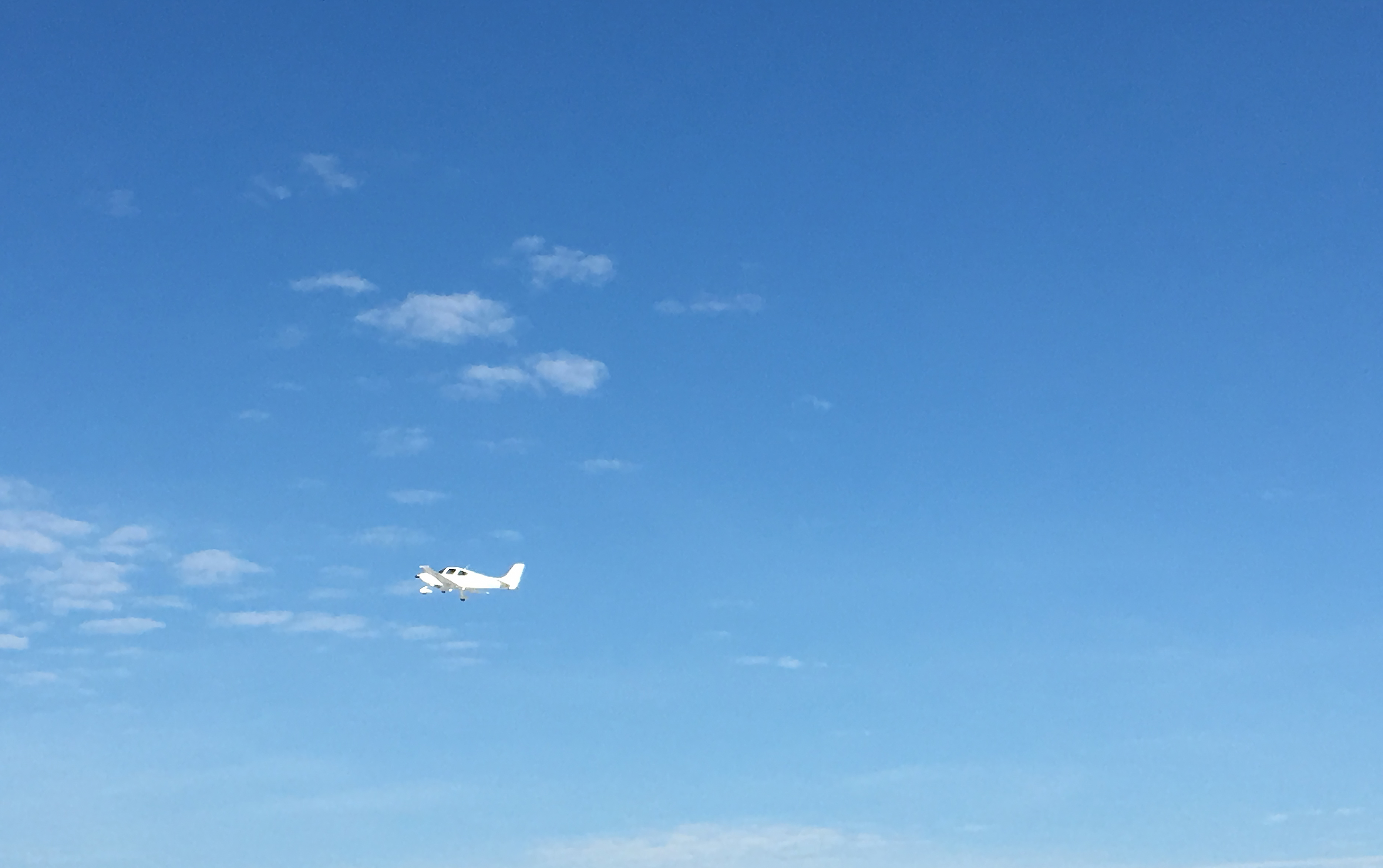
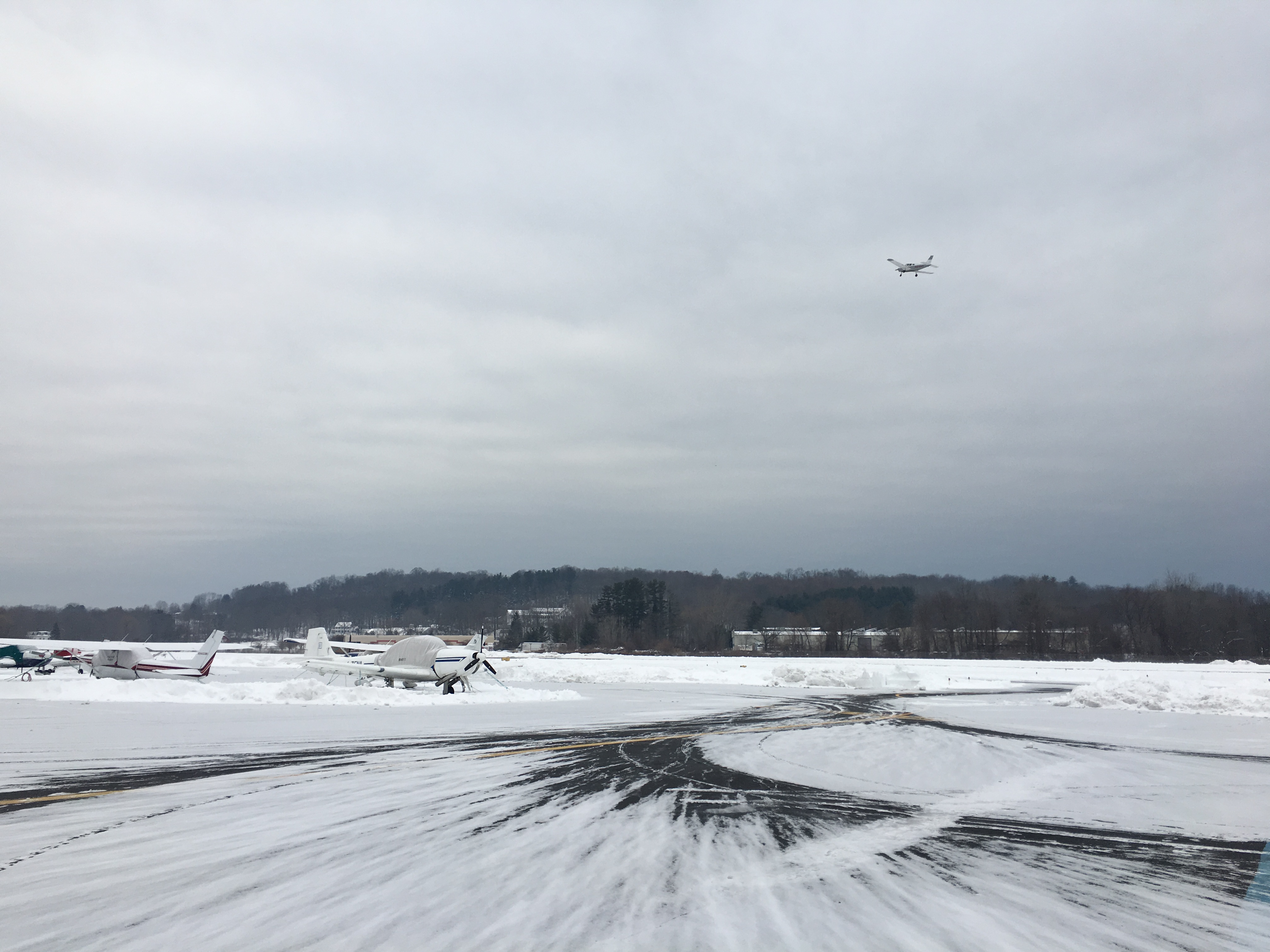
Today we had a beautiful day for flying — the temperature picked up to around 55° F and started to melt some of the snow that’s been sticking around since last weekend. The wind was calm and the skies were clear, as evidenced by this quick shot I took of a low-wing airplane doing pattern work.

Plane in the pattern at DXR

My CFI decided we would be heading out to Dutchess County (POU) again. We had an uneventful taxi and takeoff from runway 26 and I flew a right downwind departure to the northwest.

We wound up doing a total of 10 touch and go’s at POU on runway 24. I find I get pretty task-saturated in POU’s pattern — a combination of different radio calls than I’m used to and not being very familiar with the landscape. I’m not proficient yet at picking out landmarks and visualizing my pattern on the fly, so I needed a little coaching from my CFI on when to start my turns. I find I keep making the mistake of not paralleling the runway on downwind — I tend to creep in towards the runway which shortens my base and increases the workload even more.

I kept coming in high on final, so we practiced some steep descents with full (40°) flaps. Since there was no wind I was doing better at tracking the centerline, but I continue to have big issues with the roundout and flare. I’m not able to judge my distance well and keep flaring way too high. The first landing I did was actually pretty good — I saw my instructor kept his hands off the yoke and it was a moderately smooth touchdown. The rest of them, well, they were a bit harder and I needed some assistance to keep us off the nosewheel.

After our time at POU was done, we departed and tracked directly to the Kingston VOR. From there, we flew the 150° radial back to DXR where I entered right downwind for runway 26. I thought I would nail this landing as I’m more familiar with the landscape, but again I was high on approach and bad on the flare.

At least something clicked into place for me — my instructor keeps telling me to look down the side of the plane when going into the roundout and flare. I couldn’t get this through my head — when trying to judge the flare height I was so concentrated on what I was doing with the yoke that I never shifted my vision to the side. Reading the landing chapters in Rod Machado’s How to Fly an Airplane Handbook made some things more clear, and I realized I need to be looking out the “pizza slice” of the windshield — the triangle made by the left side of the cowling, the right side  of the window post, and the horizon. My instructor had told me this (minus the pizza reference) but it kept slipping my mind. Hopefully the time I spent after the flight studying and reviewing this will help me with tomorrow’s lesson.

All in all, it wasn’t a terrible flight. It was a beautiful day, and I was very happy with the cruise portion of the flight, where I kept my altitude of 3,000 feet almost perfectly the entire way to POU. That meant I had the plane trimmed properly and was able to correct for minor deviations. The landings are still shaky, but I know that will settle down with time. I also realized my instructor isn’t strictly counting our takeoffs and landings! I tracked the flight with CloudAhoy and was able to go back and see exactly how many pattern trips we made. Although we had a total of 11 takeoffs and landings, my logbook shows 7 each. No worries there, I don’t really care and I was actually wondering how the heck he managed to keep track of all of them during a busy lesson.

Click the image below to view today’s flight:

CloudAhoy flight - 02/18/2017

Flight time today: 1.7 hours
Total flight time to date: 21.3 hours
Total takeoffs to date: 52
Total landings to date: 48

A wintry mix of landings

We were hit with a pretty significant snowstorm on Thursday and I went to bed Friday night not knowing if I would have a lesson today. There was a chance of more snow overnight and the flight school called and told me I shouldn’t come in if the roads were in bad shape.

When I woke up I was pleased to see we hadn’t received any snow the night before and the roads were OK. I figured the airport would’ve had all of Friday to do snow removal… winds were calm with ceilings of 5,000 feet, so maybe we’d be going for a flight after all!

When I got to the school I noticed my CFI’s car was not there… ruh roh! I was his first lesson of the day, so I figured he was stuck in traffic or something. I was starting to get nervous around 8:20 or so when he walked through the door. Turns out he had a bit of snow at his house (he’s a bit north of us) and had to do some snow removal before he was able to get out of his driveway (yay, New England winters!)

We had now eaten up 25% of my lesson time waiting for him — we didn’t really have time to take a trip anywhere, so he suggested we stay in the local pattern and practice landings. That sounded fine to me! I was just happy to get some flight time in. I went out to preflight and took a picture of the icy ramp:

Icy ramp at DXR
The frigid wasteland I call home

We taxied out to the runup area, where I got a lesson in operating in icy conditions… we couldn’t find a great spot where all of our tires were on clean pavement, so when I increased the throttle to 1,700 RPM for the runup, the plane started sliding to the side! I quickly pulled the throttle to idle and my instructor moved the plane to a slightly better spot… we got through the magneto checks OK and we were off to runway 26!

My instructor actually did the first takeoff since there was inbound traffic and we were asked to expedite. I didn’t have the confidence or experience to taxi quickly with the icy conditions, so I was more than happy to let him have the plane. Once in the air we started our pattern work.

The calm winds definitely helped me focus on the task at hand — one less thing I had to worry about or correct for. I did a total of five takeoffs and landings (my CFI did one landing partway through the lesson to point out some things), all touch and go’s. I’m still not very consistent with my landings or my pattern work. The first trip around the circuit I felt I was just knocking the rust off. I was a bit more comfortable and ahead of the plane for the next orbits, but my actual technique execution still needs some work. I’m banking too much, I’m not managing my power enough, and I’m not trimming the plane exactly where it needs to be.

This is where my instructor took over and showed me how to fly a pattern doing a lot less work than I was doing. He had the plane trimmed for our climb out at 90mph — he initiated his turn to crosswind using just the rudder (relaxing right rudder a bit, then re-applying it and using a touch of opposite aileron to keep the bank angle shallow). When we were at pattern altitude, a quick power reduction and a touch of trim had the plane right at the altitude and speed he wanted it at. We turned downwind, called the tower, dropped the first notch of flaps, and reduced power again abeam the numbers (with another small trim adjustment to keep things where he wanted). Now we were on base at 80mph — another notch of flaps, a quick trim adjustment, turning to final, more flaps, more trim, and now we’re dialed in at 70mph on a perfect glideslope to the runway.

It was humbling, seeing how someone with 12,000 hours can put this plane where he wants it, when he wants it, with seemingly no effort at all. I have to remember I have about 0.16% of his total hours and it will take a bit of time to get this down.

My roundouts and flares were iffy — I was flaring too high. I know I’m not looking down the runway enough, my focal point keeps shifting and it shows in my shaky flare.

I had one trip around where he said I was doing everything right. My trim was better, speed was good, I was ahead of the plane and had a stable approach. Flare was high but not ridiculously so. That felt good. I feel like I’m making progress, I know eventually this will all come together.

Once we landed I was practicing the flare motion (pulling the yoke back as far as it will go) and my CFI noticed my wrist is turning while doing so, which would bank the plane to the right in an actual landing. That might be part of the reason I’ve had trouble with the flare. He suggested I move my seat back slightly, I might try that next lesson. I also practiced pulling the yoke straight back and noticed how it felt different from the motion I’ve been making. Now that I’m aware of this, I’ll be paying a lot closer attention to make sure my wrist is straight when applying back pressure.

I asked my instructor if he was having to provide less assistance on the landings — he said yes, and that he was really only stepping in if necessary. I asked if I had completed any landings unassisted, and I was a bit surprised when he told me most of them were pretty much me doing them by myself. I thought for sure he was helping with the flare, but to be honest it all happens so quickly I’m not really sure what is going on yet!

All in all a good lesson, and we had a good debrief where we spent 15 minutes or so talking about the pattern and how to apply what we’ve learned at DXR to an unfamiliar field. Looking forward to my next lesson, but it will likely have to wait — we have a forecast of ice rain for tomorrow and I suspect the airport will be closed.

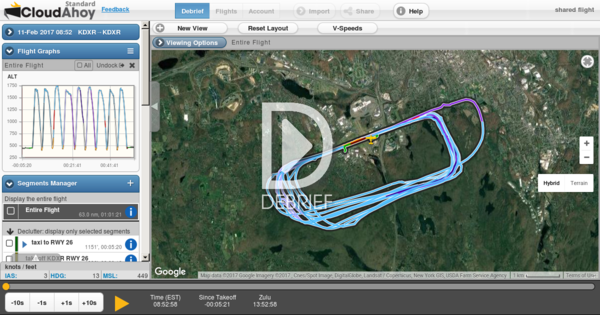
PS: I just started using CloudAhoy to track my flights. This is a really cool app that uses GPS to record and reconstruct your flight path and all associated data — airspeed, altitude, bank angle, etc… I’m using my iPhone and not a fancy, expensive, external unit so I imagine the accuracy will be spotty at times, but it’s definitely a cool way for me to review certain aspects of my flights.

Click the image below to view the recording from today’s flight. Aside from that one blue/purple segment sticking out from the rest (an extended downwind as instructed by ATC), the pattern tracks don’t look too bad, if I do say so myself!

CloudAhoy flight - 02/11/2017

Flight time today: 1.2 hours
Total flight time to date: 19.6 hours
Total takeoffs to date: 45
Total landings to date: 41

First trip to another airport! DXR to POU

Today was the day! My first landings at another field. My CFI informed me we would be heading to Dutchess County (POU) today. We headed to the classroom to brief for the flight.

We broke out the sectional and examined our route of flight. I was told we would be departing DXR to the west and intercepting the Carmel VOR’s 340° radial. This would take us more or less direct to POU. On the way back we would tune the Kingston VOR and fly the 150° radial back to Danbury. We also discussed pilotage options — basically, following some prominent interstate highways that led from Danbury to Poughkeepsie. I was excited — I had been planning for this flight for a few days now and felt like I was ready.

The mood was lighthearted as I taxied out to runway 26. It was a frigid day so we were expecting good climb performance out of ol’ N1727V. I lined up on the runway and performed the takeoff, holding runway heading until 1,500 feet.

I turned on a heading of 300° and continued climbing to our planned altitude of 3,000 feet. Once we were out of Danbury’s airspace we tuned Dutchess tower and settled into cruise. I was happy to have some time flying (mostly) straight and (mostly) level — all of this rapid fire action in the pattern recently had left me yearning for some cruise flight. I worked on keeping the plane in trim and pointed somewhat on course.

As the CDI needle crept towards center I started turning to intercept the radial. We flew the 340° radial until we were getting close to the airport — it’s only about 25nm from DXR so it didn’t take too long! I called POU tower around 10 miles out and they told me to join a left downwind for runway 24.

KPOU

We started our descent to pattern altitude of 1,200 feet and my instructor pointed out some ground references to keep me on track. We entered the downwind, slowed the plane down, and turned to base where we were given clearance to land. I turned on final and was presented with a PAPI (precision approach path indicator) — a visual indicator of proper glide slope that sits to the side of the runway. I tried to adjust my descent to keep the PAPI lights in the proper configuration. There are four lights on a PAPI — two white and two red mean you are on a perfect glide slope. If you get three or four white lights it means you are above the slope, three or four red mean you are below. We came in for a rather sloppy landing as I still have some issues keeping the plane centered on final.

PAPI lights
An example of a PAPI — the two white and two red lights to the left of the runway

After landing we turned off the runway and cleaned up the plane. We taxied back to runway 24 and I requested permission from tower to takeoff. I had a momentary bout of confusion on the radio — I am so used to flying out of Danbury the different taxiways and runway numbers threw me for a bit of a loop. Soon we were taking off of 24 and flying the POU pattern.

We did another landing, this time a touch and go. I can’t say this landing was any better than the first. Another lap in the pattern — another touch and go and we were back in the air. My instructor told tower we’d be coming in for one more landing and then heading back to Danbury.

One last sloppy landing later and we were heading home, tracking direct to the Kingston VOR. I got my first view of a VOR station from the air. We overflew the VOR as my instructor pointed out the cone of confusion, that area where the CDI needle can’t be trusted as you come directly over the station. I used line of sight to estimate where the 150° radial would take us and held the plane on that track. As we came out of the cone of confusion, I was pleased to see the needle center, confirming I was on the right course.

We called Danbury tower and were given a right traffic pattern for runway 26 as I brought us back to our home turf. I got a bit disoriented approaching the airport as my normal points of reference were all mixed up. Eventually I had us back on the ground with another crappy landing and we taxied back to the ramp.

My landings still need a lot of work, but I felt pretty good about navigating to a different airport and logging my first non-DXR landings. I left the airport today feeling a real sense of accomplishment — even though it was a very short trip, I had successfully navigated to another airport and back! Another five takeoffs and landings for the logbook.

Flight time today: 1.2 hours
Total flight time to date: 18.4 hours
Total takeoffs to date: 40
Total landings to date: 36

Did he say solo?

Today was pretty uneventful. Yesterday my instructor had mentioned we might take a trip to Dutchess County (POU) today, so I had pored over the sectional last night and did some advance planning. Alas, it was not meant to be — the weather was too crappy to leave the immediate vicinity of the airport, so we did some more pattern work.

I did much better with the actual pattern — I had the airplane trimmed more or less properly, my airspeeds were close if not dead on, and I felt like I was tracking where I needed to be. Well, everywhere except for final. I’m still having some issues with keeping the plane and nose centered while on final approach. It’s a little frustrating because one minute my CFI will say, “don’t dance on the rudder pedals!” Then, when I’m a bit more timid on them the next time around, he’ll bark, “get on those pedals!” They seem like conflicting messages, but I know what he means — I can’t be timid but I also can’t be jerky on the pedals. I need to apply the correct pressure and hold it, and I need to be commanding with the control inputs to get the plane where I need it.

Final approach is done in slow flight, which is why that was one of the first things we practiced in our early lessons. When flying slowly, there is less air flowing over the control surfaces so the controls can feel a bit mushy. They require greater travel to move the plane, so slow flight is not a time to be dainty with the plane. (Note that I don’t mean you should over control the plane — just that you need to have some authority when you’re making your inputs).

My biggest problem right now is controlling the plane while we’re in the roundout. My instructor demonstrated that you still need to fly the plane all the way down. My mind is stuck on the feeling that you are very close to the runway and you don’t want to use the ailerons, but that isn’t right (we’re probably much higher off the runway than it feels). I also keep forgetting to look down the runway during landing. The result is quite a few sloppy landings off centerline. Sigh, practice will make perfect.

When we came in after the lesson (logging another 7 takeoffs and landings), I was surprised to hear my instructor mention me soloing for the first time. Now, we still have quite a bit of work to do before I’m there, including traveling to all the local airports so he can endorse me to land there in case DXR closes for an emergency while I’m in the pattern. Still, it was great to hear him start talking about planning for that day.

One of the requirements is to complete the pre-solo written exam.

Pre-solo written exam

The written is more of a research project than an exam. The test covers a wide range of topics, everything from aircraft systems to emergency procedures to local airspace rules. I have to look up the answers to every question and also note where I found the answer — either the airplane’s operating manual, the FAR/AIM book of federal regulations, or some other document.

I took the exam home and will work on it this week. The next time we have a bad weather day, my CFI will review my answers and (hopefully) I’ll be one step closer to flying an airplane by myself!

Flight time today: 1.4 hours
Total flight time to date: 17.2 hours
Total takeoffs to date: 35
Total landings to date: 31

My first landings

Today was a milestone I’ve been waiting for since I started my training — I recorded my first landings in my logbook!

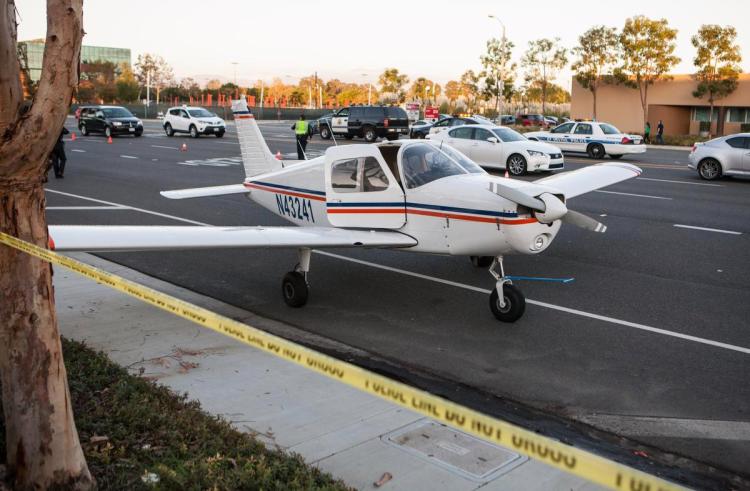
Plane after landing in street
Luckily, my landings were on the runway!

We started the lesson with some classroom time going over the pattern and each phase of the landing. The landing pattern has several distinct parts — after taking off, you turn to the crosswind leg, where you turn 90° from the runway heading (either left or right, depending on the airport or what ATC tells you to do). Then you turn 90° again into the downwind leg — this leg has you flying parallel to the runway with a tailwind, approximately one mile laterally from the runway. Once you pass the end of the runway and it is behind you at an approximate 45° angle to your wing, you turn 90° to the base leg. Then, you turn the final 90° which puts you on final approach to the runway into the wind.

Standard traffic pattern
Standard (left hand) traffic pattern

There is a lot to do when preparing to land and it got a bit overwhelming. We started with my CFI showing me the full process from takeoff to landing. Then it was my turn! My instructor handled the radio calls so I could focus on flying the plane. At DXR, we have a noise abatement procedure which requires turns to be made at 1,200 MSL, so after taking off we climbed to 1,200 feet and turned left to crosswind. My instructor gave me some local landmarks to use to judge when to turn — this is fine while I’m learning but eventually I will need to be able to do this even if I am at an airport I’ve never been to before. It is important to understand what the various distances look like so you don’t need to rely on a landmark that is specific to a certain location.

Turning crosswind, we continued our climb to DXR’s pattern altitude of 1,700 feet MSL. At this point, I reduced power and brought the nose down to hold the altitude and then turned downwind. While on the downwind leg, I lowered the flaps to 10° and my instructor called the tower to report we were on the downwind. Our speed for the downwind leg is 90mph (the Cessna 172M I am flying has its airspeed indicator in mph instead of knots), which is controlled with the elevators (pitch) and not the throttle (power). We received landing clearance to runway 26 and when we were abeam the runway numbers I reduced power once again to start descending.

I then turned onto base and dropped the flaps to 20°. I slowed the plane to the base leg speed of 80mph and turned to final.

On final approach, the flaps were lowered to 30° and the speed was lowered to 70mph. At this point, you switch to controlling the speed of the plane with the throttle and use the pitch to keep the nose held steady on your landing target. My plane has 40° of flaps and my CFI intends to teach me how to use them, so we lowered full flaps while descending to the runway. While on final approach, you use the ailerons to keep the plane tracking the centerline of the runway while using rudder to move the nose left or right to keep it centered.

As you get just about the runway, you perform the roundout where you level the plane and allow it to start to settle into the landing. At this point, my CFI says the goal is to prevent the plane from landing — you look at a point down the runway (instead of fixating on the runway right in front of you) and gradually apply back pressure to the yoke to keep it from landing — this pitches the nose up so you land on the main gears instead of the (very weak) nose gear. This final part of the landing is called the flare.

Now, from this description it may sound like I had everything under control and came in for a great landing — the real story was quite different! My instructor had to continually coach me through the process and help me with the roundout and flare to teach me when to apply the back pressure and how much pressure to apply.  We did full stop landings today, which means you actually exit the runway and clean the plane up before taxiing back to the runway to takeoff again (opposed to a touch and go, where as soon as you land you clean the plane up and apply full power to go right into another takeoff without stopping).

Another new item I learned today was how to do a short field takeoff. This technique is used when you are departing from (wait for it) a short runway and need to get to speed and off the ground as quickly as possible. Instead of pulling out onto the runway like we normally do, I taxied right up against the very edge of the threshold to maximize how much runway I’d have to work with (we were doing these on DXR’s runway 26, which is over 4,000 feet long, but sometimes you just have to pretend!) In a short field takeoff you hold the brakes while applying full throttle, and once the engine is at full power you release the brakes and off you go!

I wound up doing a total of four trips around the pattern, with four takeoffs and landings being recorded in the logbook. The winds were pretty calm and I felt like I was starting to get the hang of flying the pattern. I still wasn’t completely confident on my final approaches, but I’ve been told landings take a lot of practice. I’m confident that in time I will be performing all of the steps smoothly and confidently (at least some of the time!)

I left the airport feeling like I had taken a big step towards actually being a pilot — it was a great feeling of progress and I can’t wait to get some more practice in!

Flight time today: 1.2 hours
Total flight time to date: 11.3 hours
Total takeoffs to date: 8
Total landings to date: 4