More straight & level flight

Today we started with a quick ground school lesson retouching on the four fundamental forces of flight. I then went out to N1727V and did my preflight while being watched by my CFI. I did my first radio calls, first to Danbury ground to request taxi clearance, then to the tower when we were ready for takeoff.

This was my first time using my new David Clark headset and all went well! I love the sound quality and don’t mind that they aren’t noise cancelling. At this stage in my training I want to hear the noises the airplane is making so I have a chance of knowing if something isn’t working correctly.

I still don’t feel entirely comfortable taxiing — I can hold a straight line now, but have some problems with speed control and shifting my feet to the brake portion (the rudder pedals act to steer the nosewheel on the ground — the lower portion of the pedals can be depressed to steer left and right, while the tops of the pedals activate the brakes).

My CFI did the takeoff again and we went to the practice area to work on my basic maneuvers — straight & level flight with the airplane properly trimmed and various types of turns. After we were done, my CFI had me fly back to the airport where he took over and landed, explaining the process as he did so.

One thing my instructor is very big on is flying using the sight picture out the windows instead of relying on your instruments. After all, instruments can fail at any time (especially during training when your CFI decides to cover one of them!), so learning what looks “right” for a given maneuver is very important. You can tell what the plane is doing by using visual clues, such as how the nose is pitched relative to the horizon, or the angle the wing is making with the horizon out the side window. This is something I’m struggling a bit with — there are a lot of different attitudes to learn (level flight, different bank angles while turning, etc…) and it is going to take some time before I know what looks and feels correct.

So, some stuff is starting to click and other stuff still seems well above my ability. I’ve been told this is a normal feeling during training, but it is a bit discouraging — I’d like to think I am a natural pilot and would take to this like a duck to water, but it seems this will take quite a bit of work to master. I didn’t expect any less, but I’m still a bit frustrated that I’m not naturally gifted as a pilot!

Flight time today: 0.9 hours
Total flight time to date: 2.7 hours
Finally in the air again!

Today the weather finally cooperated and I tasted flight again!

We started off with a lesson on how to preflight the airplane. I am flying a 1975 Cessna 172M (N1727V). The preflight is not rocket science, but there are a lot of details that need to be checked prior to taking to the skies.

The preflight is your one opportunity to catch a problem with the plane on the ground before it becomes a problem in the air. We check the general condition of the aircraft, all of the flight surfaces, the fuel quality (testing for water and other contaminants as well as the proper fuel type), the lights, oil, prop condition, tires and brakes — basically a thorough check of everything that could make the difference between a pleasant flight and an emergency in the making.

After learning how to preflight I took to the left seat for my first flight in N1727V. I taxied to the runway (still very uncoordinated) and my CFI performed the takeoff while explaining what he was doing. We climbed out and headed to the practice area.

I did have one equipment failure on this flight — luckily, it wasn’t something on the plane! My headset (one of the flight school loaner sets) started cutting in and out, making it impossible to hear my CFI tell me what was going on. I had to bend the headset cable trying to find a spot where they worked, then sit on the cable to try and keep them working. Then everything would be good for a minute or two until I shifted in my seat a bit and had to start the whole process all over again. It was difficult and distracting but at least I was able to get 90% of what my instructor said and didn’t have to scratch the lesson.

We practiced straight & level flight, level turns, and I started to learn how to trim the aircraft. The C172M has elevator trim, which basically means there is a wheel I can turn to take the pressure off of the elevator. Practically, this means once I achieve a certain speed or attitude of flight, I can adjust the trim wheel so I don’t have to continually apply pressure to the yoke. This is not only a convenience factor (constantly applying forward or back pressure to the yoke will become tiring over a long flight), but also a safety issue — the plane should always be in trim so you aren’t fighting the aircraft during maneuvers.

The flight was over before I knew it. My CFI landed and we taxied back to the ramp. As soon as we landed I bought one of the ubiquitous mint-green David Clark headsets…no more nasty loaners for me!

Flight time today: 0.9 hours
Total flight time to date: 1.8 hours

Ground School – Aerodynamics

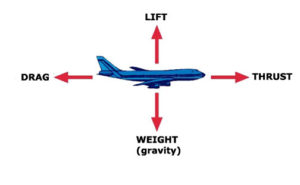
Saturday, December 3rd was a bit of a nasty, rainy day, so we headed to the classroom to cover the basic aerodynamic principles of flight. Every aviator needs to be aware of the four forces — lift, drag, thrust, and weight:

The four forces of flight

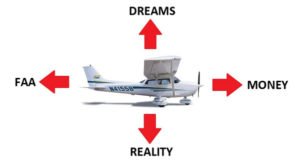
Or, as the more pragmatic pilots see them:

The four REAL forces of flight

We talked about how these forces would impact straight & level flight, level turns, and climbing & descending turns. We touched on P-Factor, adverse yaw, and a bunch of other topics that went over my head but will be explored in more detail later.

Finally, we completed my IACRA registration for my FAA student pilot certificate. I will need this certificate to solo — quite a ways off yet, but no reason to delay applying for it!

Can’t wait for my next lesson tomorrow!


Ground School – Aircraft systems

I went to the airport for my first “real” lesson and was a bit disappointed to learn that we would not be taking flight this morning. It makes sense, there’s a lot to learn about how this all works first. While fun, it would be a waste of money to go up and mess around in the air without at least a cursory understanding of what I’m doing.

Today we worked on aircraft systems. My CFI went over all of the major systems of the aircraft — electrical, ignition, engine, fuel, and vacuum. We touched on the flight instruments and where they get their information from.

We also reviewed the airport diagram for my home airport, DXR, and discussed radio comms for this airport (DXR is a towered Class Delta field, so I’ll be talking to tower every time we fly).

A lot to take in, but I’m up to the challenge!

Getting my medical certificate

One of the requirements to hold a private pilot’s license is having a valid medical certificate from the FAA. These certificates come in three classes — third class is the easiest to get and the one I will be going for. That is all you need to be a private pilot who is not flying for hire. If you want to do any kind of commercial work while flying (crop dusting, transporting cargo, etc…) you would need at least a second class medical. First class is really only required for airline transport pilots and is the most difficult to get.

Medical flight wings

The process to get my medical was a little tricky, but all in all not a terrible experience. The hardest part was completing the FAA application online — this requires you to document your last three years of doctor visits, no matter how minor or what they were for. I had to do some digging to get a complete list together — my insurance company was helpful here and provided me a list of my claims over the last three years.

Next you have to go down a list of conditions and disclose if you have ever been diagnosed or treated for them. The FAA is obviously concerned with conditions that could be hazardous in flight — things like heart conditions, epilepsy, depression, alcohol or drug abuse, etc… Some conditions are disqualifying — unfortunately if you have one of them you may never be able to fly a plane solo. A lot of conditions will be allowed but you may need to jump through some difficult (and very expensive!) hoops to get the FAA to make an exception for you.

The advice I was given — if you have any doubts if something in your medical history will affect your application, do not apply yet! Talk to an AME (aviation medical examiner) before you submit anything. There are great AMEs out there who will act as your advocate and help you maximize your chances of getting a cert. Once you apply and get denied or deferred, you can’t take it back and just try again! Even though I am relatively healthy, I still contacted an AME to discuss some minor issues and it definitely helped with my peace of mind.

Another piece of advice — get your medical as soon as possible! I’ve heard horror stories of students who spend thousands of dollars and months of their life training to get to their solo endorsement, only to find there is some condition that will prevent them from ever holding a license. I did NOT want to go through that experience, so I decided I wouldn’t take any more lessons past the discovery flight until I had the medical in hand.

After submitting my application, I needed to see an AME for the physical exam. Our flight school has a great AME that sees patients right at the airport, so I booked an appointment and went to see him tonight. The exam was not as intrusive as I feared — again, you can find some horror stories out there! I was done in about 15 minutes and walked out with my new medical certificate in hand!

Discovery flight

I don’t remember exactly when my love for aviation started, but it reached critical mass today.

Until now, I had sated my love of all things flying with simulators. I had been simming on and off for years, always dreaming of taking lessons. I had gotten to the point of emailing a few flight instructors for information, but had never seriously followed up. I always found a reason to postpone starting the process — finances, time, family…there was always some reason.

That all changed today.

My wonderful wife bought me an intro flight for my 40th birthday, and I plunged head-on into the world of flight training.

This is my story.

I was paired with my flight instructor as if it was destiny. My wife bought the intro flight, all I had to do was schedule it… I decided to wait until I was sure I could dedicate myself to the training — I wound up with a week off of work and selected November 9th, one day after my birthday, as the day I would take my intro flight. As fate would have it, November 9th was a rainy, crappy day — even with no weather or flight knowledge, I knew I wouldn’t be going up that day. As fate would also have it, my wife had secretly scheduled the flight for today, November 12th! It really worked out well since Wednesdays are my CFI’s regular day off, so if the weather had been better that day I would’ve been paired with a different instructor.

I showed up this morning to Danbury Airport (DXR) and met my instructor. He’s an old-school stick & rudder pilot with 12,000 hours — exactly the kind of guy I wanted to teach me how to fly right. I knew within 5 minutes that this was the type of instructor I wanted — one who might take a while to sign me off to solo, but once he did, I would know I was truly ready. I didn’t want to check some boxes off a checklist, I wanted to learn how to be a really great pilot.

We headed out to the plane and he told me the purpose of the flight was to see if I was really into this and wanted to learn how to fly. I already knew the answer, but I appreciated that he needed to know as well. I climbed into the left seat of N474EP, a Cessna 172R, and my journey began.

The flight is really a bit of a blur — I remember taxiing out to the runway, looking a bit like a drunken sailor weaving about the taxiway centerline as I learned to use the rudder pedals to steer. My CFI performed the takeoff and then had me do some straight and level flight and some basic turns. As soon as it started it seemed like it was over and my CFI took the controls and landed us back at DXR. I knew one thing — I was hooked and was ready to commit to the journey to earn my PPL.

As soon as we landed I booked my next lesson and bought the flight school’s student package (a flight bag, logbook, a bunch of textbooks, and an E6B and plotter). I left feeling like I was on the cusp of something great in my life, and I can’t wait for the date of my next lesson to arrive.

Flight time today: 0.9 hours
Total flight time to date: 0.9 hours